
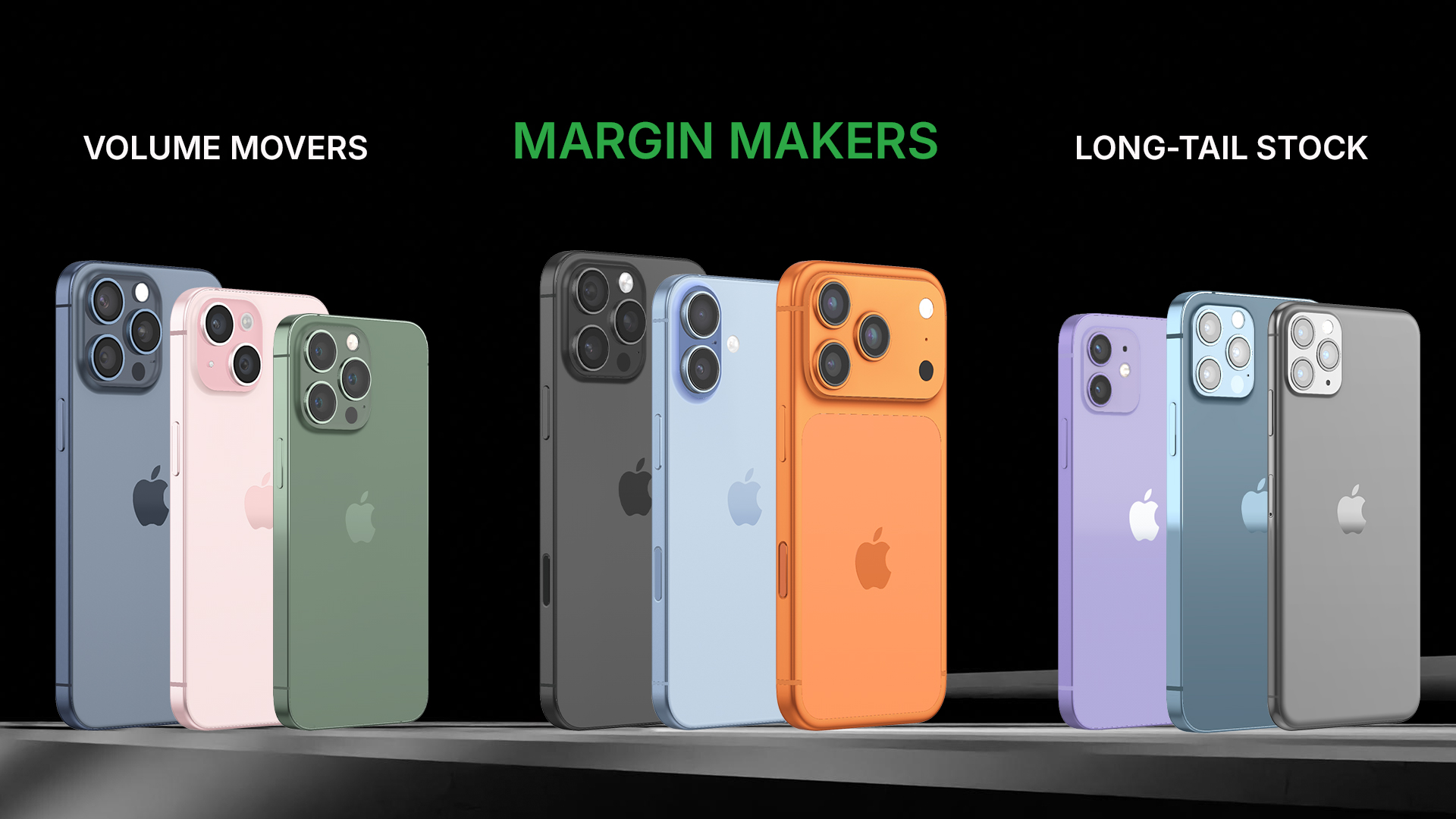
The best refurbished iPhone for a customer to buy and the best refurbished iPhone for a reseller to stock are not the same question. A consumer wants specs, cameras, and how many years of updates are left. A reseller wants to know what moves, what makes money, and what sits on the shelf.
This guide ranks the most popular refurbished iPhone models by what actually matters to your business: sell-through speed, margin potential, return risk, and how long demand will hold. If you are building or adjusting your stock mix for late 2026 and into 2027, this is the breakdown.
How we ranked these models
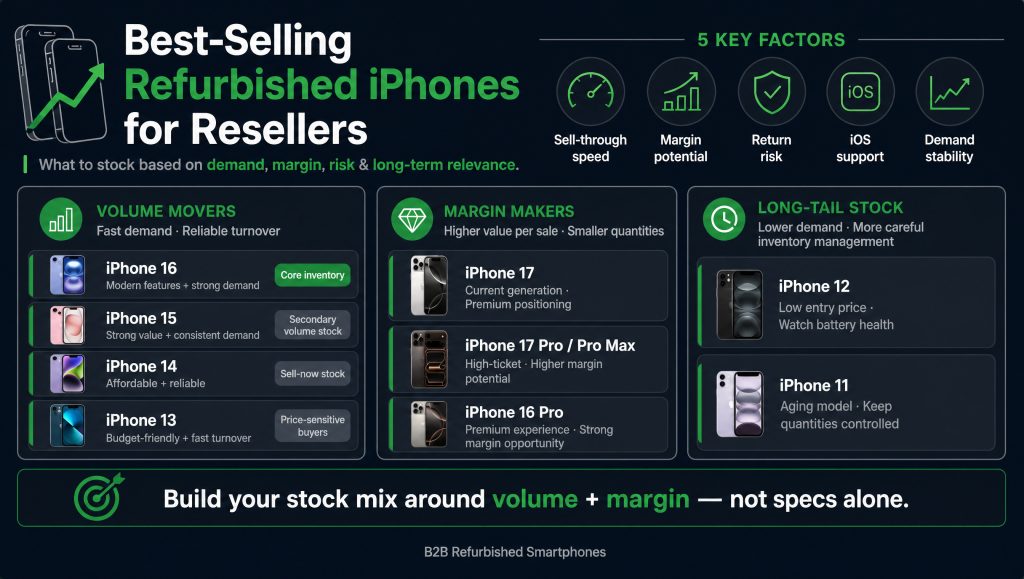
We did not rank by specs or benchmark scores. A reseller’s best seller is not always the newest or most powerful phone. It is the one that balances five things:
- Sell-through speed: how quickly it moves once listed.
- Margin potential: the gap between what you pay and what you can sell it for after all costs.
- Return risk: how often buyers send it back, and why.
- Remaining iOS support: how long Apple will keep updating it, which directly affects how long buyers will want it.
- Demand stability: whether the model sells steadily or swings with trends and launches.
Every model below is measured against those five, grouped into three tiers so you can build a stock mix that balances volume, profit, and risk.
The volume movers
These are the models with the highest and most consistent demand. They will not give you the fattest per-unit margin, but they turn fast, generate repeat business, and keep your cash flow healthy. Most resellers should carry these as the backbone of their inventory.
iPhone 16
The iPhone 16 has moved into the sweet spot that drives the refurbished market. Now one generation behind the current iPhone 17, it has the combination that sells fastest: modern enough to feel current, priced well enough below new to make the deal obvious.
The A18 chip supports Apple Intelligence, which matters more every month as Apple expands what AI features can do. USB-C, the Camera Control button, and strong battery life round out a phone that checks every box a buyer looks for. Refurbished pricing starts around $440 for the base model, compared to $799 new. That gap is where your margin lives.
Supply is growing steadily as trade-ins from the iPhone 17 launch cycle work through the refurbished pipeline. For most resellers, the iPhone 16 should be the deepest part of your inventory right now. It moves fast, the margin is solid, and return rates are low because the phone meets expectations easily.
iPhone 15
Six months ago, the iPhone 15 was the top pick. It is still an excellent seller, but the iPhone 16 has taken over the lead position now that refurbished supply of the 16 has matured.
The iPhone 15 remains the phone that brought USB-C and Dynamic Island to the standard iPhone lineup, and buyers still respond to both features. At refurbished prices starting around $336, it offers the strongest dollar savings against the original new price of any model in the lineup. That makes it the best value play in the market and a reliable seller in price-conscious segments.
Where it loses ground is Apple Intelligence. The standard iPhone 15 runs an A16 chip, which does not support Apple Intelligence. As AI features become more visible to everyday buyers, this will gradually soften demand. For now, the 15 still moves well, especially in 128GB across Grade A and Grade B. Stock it as a strong secondary to the iPhone 16.
iPhone 14
The iPhone 14 is the reliable middle of the lineup. It does not excite anyone, and that is exactly why it sells. Buyers who do not need USB-C or Dynamic Island can get a phone that still runs the latest iOS smoothly, takes good photos, and lasts a full day, all at a lower price point.
Refurbished pricing starts around $230, making it one of the most accessible iPhones that still feels genuinely good. Margins per unit are moderate. The risk is that the iPhone 14 is the last standard iPhone with Lightning, and as USB-C becomes expected by most buyers, demand for Lightning models will continue to soften. The 14 is a sell-now model, not a stock-deep-for-next-year model.
iPhone 13
The iPhone 13 is the budget anchor of the refurbished market. It is the cheapest model that still feels genuinely good to use, and it remains fully supported on the latest iOS. For resellers serving price-conscious buyers, this is the volume play.
The margin per unit is the thinnest of the volume movers because the resale price ceiling is low. Where the iPhone 13 earns its place is turnover. It moves fast, especially in 128GB, and buyers at this price point tend to be less particular about cosmetic grade, so your Grade B and Grade C stock sells here without heavy discounting.
The trade-off is return risk. Budget buyers occasionally expect more than the price justifies, so honest listings matter even more at this tier. State the grade, state the battery health, set the expectation, and returns stay manageable.
The margin makers
These models deliver the highest per-unit profit. They sell slower than the volume movers because the price points are higher, but each sale contributes more to your bottom line. Stock these in smaller quantities and let them do the heavy lifting on margin.
iPhone 17
The iPhone 17 is the newest model on the refurbished market. It launched in September 2025 and refurbished units started appearing around December, roughly 82 days after launch, which is typical for a new iPhone.
Supply is still thin and the discount over new is modest, around 12 to 15 percent on the base 256GB model. Refurbished pricing starts near $700 compared to $799 new. That is a smaller gap than any other model in the lineup, which means your per-unit margin depends heavily on your sourcing cost. But for resellers who can source it well, the iPhone 17 is prestige stock. It is the current-generation iPhone with the A19 chip, Apple Intelligence, the new Center Stage front camera, and ProMotion on the standard model for the first time. Buyers who want the newest phone at a lower price are your audience here.
Stock it in small, controlled quantities. The capital tied up per unit is high, turnover is slower than the volume tier, and if Apple adjusts pricing or announces a new model, the value of your stock shifts fast. But each sale delivers a premium.
iPhone 17 Pro and Pro Max
The iPhone 17 Pro sits at the top of the refurbished lineup in both price and margin. Refurbished units start around $849 for the 256GB Pro, compared to $1,099 new, a saving of roughly 23 percent.
The A19 Pro chip, Apple Intelligence, the advanced camera system, and the new aluminum unibody with vapor chamber cooling make this a phone that holds its perceived value well. Buyers at this price point know what they are getting, which means return rates are low and customer satisfaction runs high. The Pro Max commands an even higher price but moves slower because fewer buyers will spend that much on refurbished. Stock the Pro more heavily than the Pro Max unless your market skews premium.
Supply is the constraint. Apple’s own Certified Refurbished store has not listed the 17 series yet, so third-party refurbishers and marketplaces are the current source. As trade-in volume grows through late 2026, supply will deepen and sourcing costs will ease.
iPhone 16 Pro
The iPhone 16 Pro has quietly become one of the strongest margin plays in the market. Now that the iPhone 17 Pro has taken over as the newest flagship, refurbished 16 Pro supply is growing and sourcing costs are dropping, while demand remains strong because it still supports Apple Intelligence via the A18 Pro chip.
Refurbished pricing starts around $581, well below the original $999 new price. The titanium build, ProMotion display, and excellent camera system still feel premium. For resellers, this model hits an ideal spot: lower sourcing cost than the 17 Pro, strong per-unit margin, and steady demand from buyers who want a Pro experience without paying for the very latest.
The long-tail stock
These models still sell, but they need more careful handling. Margins are thin, demand is softening, and the window of relevance is narrowing. Stock them if your market demands budget options, but do it with your eyes open.
iPhone 12
The iPhone 12 is still supported on the latest iOS, which keeps it viable for now. It is very cheap to source, and in price-sensitive markets it gives buyers a 5G-capable iPhone with MagSafe for well under $200 refurbished.
The challenges are real, though. It uses Lightning, the design is four years old, and battery health on units this age has often dropped past the 80 percent mark unless it has been replaced. If you stock the iPhone 12, keep quantities small, verify battery health strictly, and position it as the entry point to iPhone ownership.
iPhone 11
The iPhone 11 sits on the edge. It received the latest iOS, but it is widely expected to lose support with iOS 27 in late 2027. Once that happens, buyer interest drops sharply.
Source the iPhone 11 only if you can move it quickly and cheaply. It is a fast-depreciating asset at this stage. Holding iPhone 11 stock into 2027 without a clear sell-through plan likely means discounting heavily or sitting on dead inventory.
The Apple Intelligence factor
Apple Intelligence is reshaping the refurbished iPhone market, and resellers who ignore it will feel the shift in their sell-through data.
The cutoff for full Apple Intelligence support is the A17 Pro chip and newer. That means the iPhone 15 Pro is the oldest model that qualifies, along with the entire iPhone 16 series (including the 16e), and the full iPhone 17 lineup. Everything below, the standard iPhone 15 included, does not support Apple Intelligence.
What this means for your stock mix is straightforward. Models with Apple Intelligence support will hold their resale value better and longer than models without it. The standard iPhone 15, 14, and 13 are still good sellers today, but their pricing ceiling will erode faster as AI features become more visible and more expected.
The iPhone 16 is the most accessible entry point for buyers who want Apple Intelligence at a refurbished price. The iPhone 15 Pro remains the cheapest AI-capable Pro option. And the iPhone 17 lineup sits at the top for buyers who want the newest AI-capable hardware. If you are planning inventory into 2027, shift your mix gradually toward AI-capable models. The demand signal is already clear and getting stronger.
Timing your stock around new launches
Apple typically launches a new iPhone every September. However, Apple has confirmed that the next standard iPhone, the iPhone 18, will arrive in spring 2027 instead of fall 2026. The iPhone 18 Pro and a foldable model are still expected in fall 2026.
Here is how the cycle plays out. In the months before a launch, demand for current refurbished models stays steady. When the new model is announced, resale prices on every older model drop, sometimes quickly. The biggest drop hits the model that just moved from current to previous generation. After launch, trade-ins and returns begin entering the refurbished supply chain in roughly 60 to 90 days, pushing sourcing costs down.
The practical takeaway: do not overstock ahead of a major launch. Keep capital flexible for the sourcing price drops that follow. The best buying window for refurbished stock is usually the two to four months after a new launch, when supply from the new cycle hits the market.
One more thing to watch. The iPhone Air launched at $999 and depreciated nearly 48 percent shortly after release. That kind of rapid value drop is a warning for resellers thinking about stocking niche models with uncertain demand. Stick with proven sellers unless you have strong data that your market wants something different.
FAQ
Which single refurbished iPhone model should I stock the most of?
The iPhone 16, for most resellers in late 2026. It has the strongest combination of demand, margin, Apple Intelligence support, and sell-through speed. Stock it in 256GB and 128GB across Grade A and Grade B for the widest buyer coverage.
Is it worth stocking iPhone 17 refurbished already?
In small quantities, yes. Supply is still thin and the discount over new is modest, so per-unit margin depends on sourcing well. It works as prestige stock for buyers who want the current generation at a lower price. Do not stock deep until supply matures and sourcing costs drop.
Should I still stock iPhone 13s and 14s?
Yes, if your market includes budget-conscious buyers. Both still move, especially in regions where price sensitivity is high. Keep volumes moderate and watch for demand softening as the pricing gap between these and the iPhone 15 or 16 narrows.
When should I stop stocking a model?
When it loses iOS support or is about to. Once Apple drops a model from the next iOS version, buyer demand falls quickly. Start reducing stock six months before the expected cutoff.
How does Apple Intelligence affect what I should stock?
It raises long-term demand for iPhone 15 Pro and newer, plus the entire iPhone 16 and 17 lines. Models without Apple Intelligence still sell today but will depreciate faster. Shift your mix toward AI-capable models as you reorder.
Conclusion
The best stock mix for a reseller is not the newest or the cheapest lineup. It is the combination that balances fast-turning volume, strong per-unit margin, and low return risk. Build your backbone around the iPhone 16, use the 16 Pro, 17, and 17 Pro for margin, and fill the budget tier with the 15, 14, and 13 while they carry demand. For sourcing any of these models in bulk with verified grading, battery health, and clean IMEIs, explore our range at remobile.ae.