
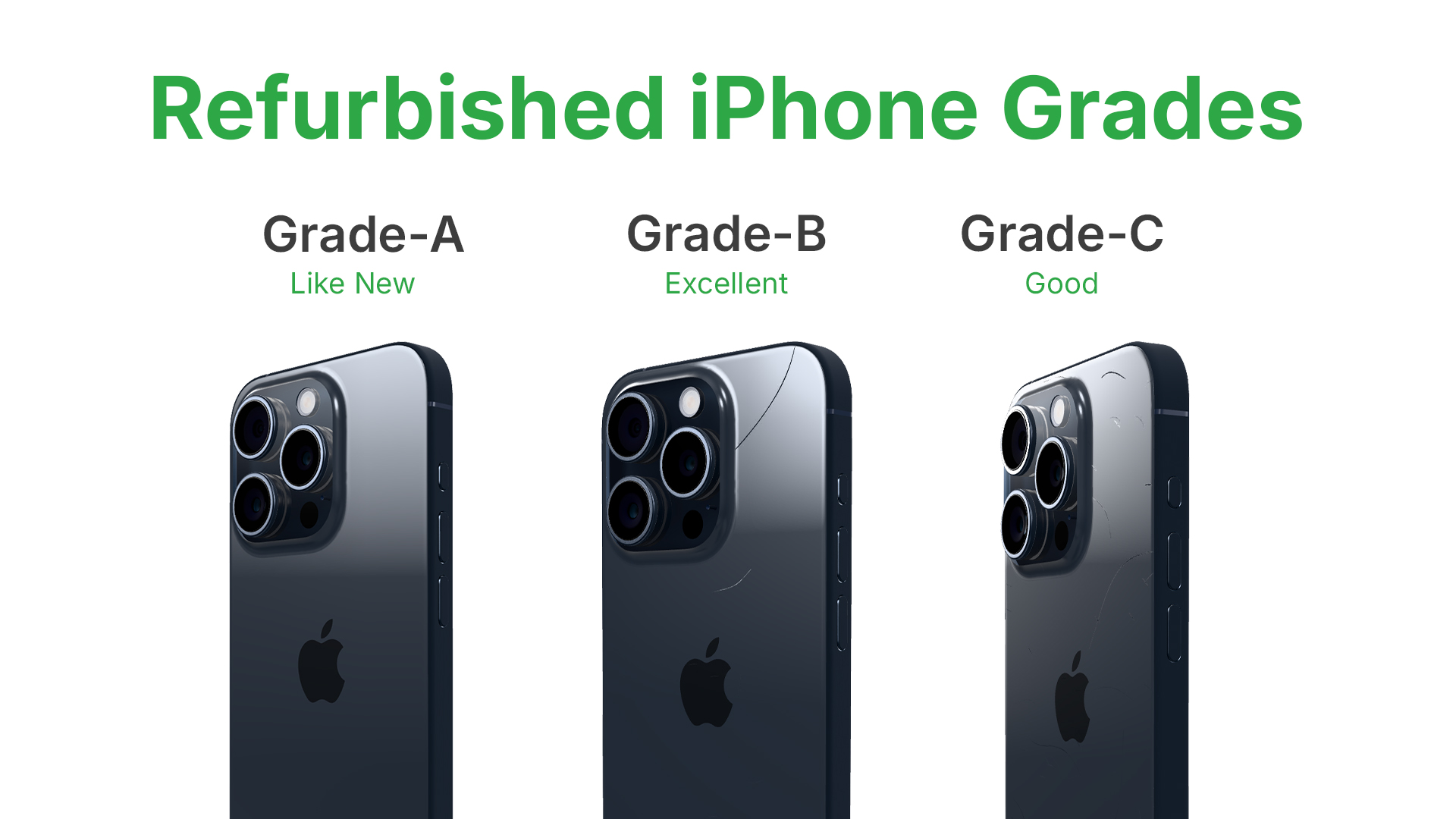
Refurbished iPhone grades tell you one thing: how the phone looks. They do not tell you how it works. Every properly refurbished iPhone should be fully functional regardless of grade. The grade is a cosmetic rating, and it drives the price, the margin, and the type of customer who will buy it.
For resellers, understanding grades goes beyond knowing the definitions. It means knowing which grade to stock for your market, how grading inconsistency between suppliers can quietly destroy your margins, and what a proper grading process should look like before you trust it. This guide covers all of it.
What the grades mean
The industry uses a three-tier letter system: A, B, and C. Some suppliers add plus or minus sub-grades, but the core framework is the same everywhere. What is not the same is how strictly each supplier applies it, which we cover further down.
Grade A — Like New
A Grade A iPhone shows minimal signs of previous use. The screen is flawless or near-flawless with no visible scratches. The housing is clean with no chips, dents, or discoloration. Pick it up and it looks like it just came out of the box.
Grade A commands the highest resale price and appeals to buyers who care about aesthetics as much as function. Retail consumers buying a personal device, corporate buyers outfitting office staff, and anyone who wants the refurbished phone to feel new will gravitate here. It is also the easiest grade to sell online because photos look clean and customer expectations are met without surprises.
The trade-off is sourcing cost. Grade A stock costs the most to buy, which means the absolute margin per unit can be thinner than you expect unless you price confidently. It works best in markets where buyers will pay a premium for condition.
Grade B — Excellent
Grade B is the workhorse of the refurbished market. These iPhones show light cosmetic wear: small scratches on the frame or back, minor scuffs you have to look for, maybe a faint mark on the screen that disappears when the display is on. Functionally, the phone is identical to Grade A.
For most resellers, Grade B is the sweet spot. The sourcing cost is lower than A, the resale price is still strong, and the margin per unit is often the best in the lineup. Buyers at this level care about getting a good phone at a fair price and are not bothered by a light scratch on the back that a case will cover anyway.
Grade B also moves well across a wider range of customer segments: everyday consumers, students, parents buying for children, and small businesses. If you are stocking one grade more than any other, this is usually the one.
Grade C — Good
A Grade C iPhone has visible signs of previous use. Expect noticeable scratches, scuffs on the housing, and possibly small dents or marks on the screen. The phone works perfectly, but it has clearly been used and it shows.
Grade C sits at the lowest price point and appeals to the most budget-conscious buyers. It is also popular with repair shops that plan to swap the housing or screen anyway, and with resellers serving markets where price is the primary driver and cosmetics matter less.
Here is the honest part. Grade C carries the highest return risk of any tier, and almost every return at this level comes down to expectation mismatch, not function. The phone works fine, but the buyer expected it to look better than it does. The fix is simple: describe the condition clearly in your listing, show real photos, and state the grade upfront. Honest listings at Grade C sell well and stay sold. Vague listings at Grade C come back.
Why grading standards differ between suppliers
There is no enforced global standard for refurbished phone grading. No certification body defines what Grade A must look like. Every supplier publishes their own rubric, and that is where things get messy for resellers.
Two suppliers can quote you Grade A on the same iPhone model at a $30 to $50 price difference. Neither is lying. They are using different standards. One supplier’s Grade A might allow a few micro-scratches on the frame. Another’s Grade A might mean zero visible marks under any light. Both call it Grade A, but the phones look different and your customers will notice.
This inconsistency is the single biggest source of surprise cost in bulk buying. You price your stock based on what you think Grade A means, and when the phones arrive looking closer to your definition of Grade B, your pricing is wrong and your margin just shrank.
Three things protect you:
First, request the supplier’s written grading rubric before your first order. A serious supplier will have one. If they cannot tell you in writing what each grade allows and does not allow, you are buying blind.
Second, compare grades within a supplier, not across suppliers. Once you find a supplier whose Grade B consistently matches what arrives in the box, that consistency is what you are paying for, not the letter itself.
Third, use a test order to verify. Order a small mixed batch across grades and compare what arrives to the stated rubric. One test order answers the grading question more reliably than any conversation.
How grades affect your business
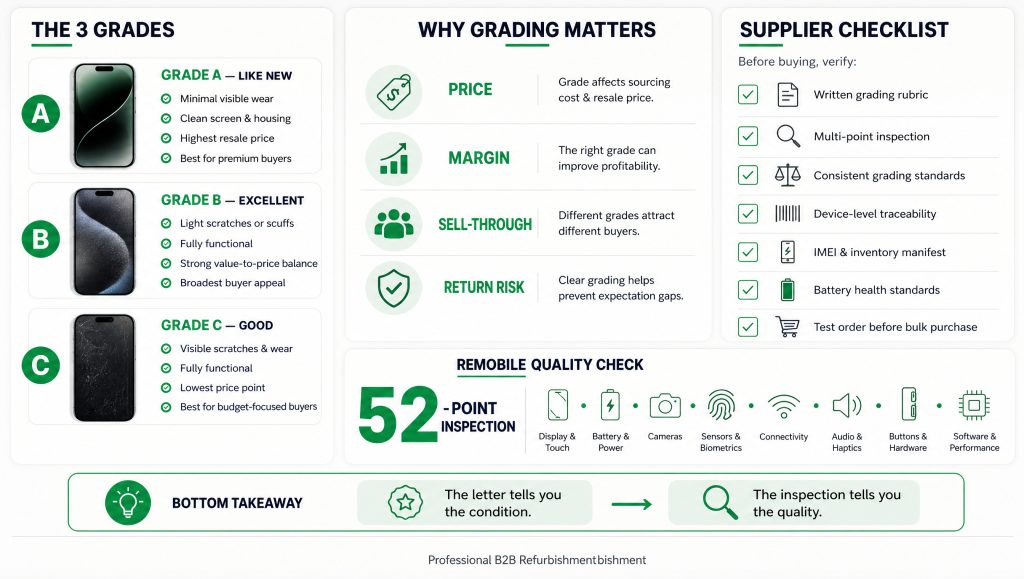
Grades are not just labels. They directly shape three things that determine whether a batch makes money or creates problems.
Pricing and margin by grade
Grade A commands your highest resale price but also costs the most to source. The margin per unit can be strong, but only if your market supports premium pricing. In price-sensitive markets, Grade A can sit longer than Grade B because the price gap between them matters more to buyers than the cosmetic gap.
Grade B usually delivers the best margin as a percentage. The sourcing cost is meaningfully lower than A, but the resale price does not drop by the same amount. That gap is your advantage. Grade B is where most resellers make their money consistently.
Grade C has the lowest sourcing cost and the lowest resale price. The margin can be decent in absolute terms, but the return rate is higher, and every return eats into that margin. Grade C is profitable when you list honestly and your market genuinely shops on price. It is unprofitable when you try to sell it as something it is not.
Sell-through speed by grade
Grade A moves fastest in markets where buyers value aesthetics and trust. Online retail, corporate purchasing, and mature refurbished markets respond well to Grade A.
Grade B moves fastest in the broadest range of markets. It is the grade with the widest buyer pool, from consumers to small businesses to education. If your goal is turnover and cash flow, Grade B is the backbone.
Grade C moves fastest in price-driven markets and through channels where the buyer plans to case the phone immediately or is buying for function, not appearance. It also moves quickly to repair shops and housing-swap operations.
Return risk by grade
Returns at Grade A are rare. The phone looks and works like new, so there is very little gap between expectation and reality.
Returns at Grade B are low, as long as the listing states the grade clearly. The occasional return here is usually a buyer who expected Grade A and did not read carefully.
Returns at Grade C are the highest of any tier, and the cause is almost always the same: the buyer did not expect the level of cosmetic wear. This is a listing problem, not a product problem. Photos, honest descriptions, and a clear statement of what Grade C means will cut your return rate significantly.
What good grading looks like from a supplier
A supplier’s grading is only as trustworthy as the process behind it. Letters on a listing mean nothing if the inspection is shallow or the criteria change from batch to batch. Here is what to look for when evaluating a supplier’s grading process.
A proper process starts with a documented, multi-point inspection that covers every major function of the phone, not just the outside. At ReMobile, every iPhone runs through a 52-point inspection across eight categories: display and touch, battery and power, camera system, sensors and biometrics, wireless and connectivity, audio and haptics, buttons and hardware, and software and performance. A single failure on any checkpoint sends the device back for rework. No exceptions, no “close enough.”
Battery handling is a strong signal of supplier quality. Many suppliers grade and ship with whatever battery the phone arrived with, leaving you to deal with the health question downstream. ReMobile fits a brand-new battery to every iPhone regardless of grade, which means every unit ships at 100 percent battery health. That removes one of the most common variables in refurbished stock and simplifies your pricing because battery health is no longer a per-unit question.
Beyond the inspection, look for traceability. Each device should carry a unique identifier tied to its intake, testing, grading, and certification. A manifest that lists IMEI, model, storage, grade, and battery health per unit is the baseline. If a supplier cannot produce that for every order, the grading process is not as tight as they claim.
Consistency matters more than any single order being perfect. The real test is whether your fifth order from the same supplier matches the same standard as your first. That kind of reliability is what turns a supplier into a partner.
FAQ
Is Grade B really the best grade for resellers?
For most resellers, yes. It offers the best balance of sourcing cost, resale price, and margin. Grade A works well in premium markets, and Grade C works in budget markets, but Grade B covers the widest buyer pool and produces the most consistent profit.
Should I stock all three grades?
It depends on your market. If you serve a range of buyers, stocking A and B gives you coverage without the higher return risk of Grade C. If your market is strongly price-driven, adding Grade C makes sense, but list it with full transparency to keep returns down.
How do I handle a supplier whose grading does not match what arrives?
Document the gap with photos, raise it immediately within the returns window, and request credit or replacement. If it happens on a second order, the supplier’s grading is unreliable and you should source elsewhere. One inconsistency is a mistake. Two is a pattern.
Does the grade affect the phone’s function or performance?
No. Grade is cosmetic only. A properly refurbished iPhone at Grade C should work identically to one at Grade A. Every grade passes the same functional tests. The only difference is how the phone looks.
What does it mean when a supplier uses sub-grades like A+ or B-?
It means they have added more granularity to the basic A/B/C system. A+ is typically near-mint with no visible marks, while B- might sit at the boundary between B and C. The specific meaning varies by supplier, so always check their rubric. Sub-grades can be useful for finer pricing, but they also increase the chance of inconsistency across orders.
Conclusion
Grades tell you how a phone looks, not how it works, but for a reseller they shape your pricing, your margins, and your return rate. Know what each grade means, verify that your supplier’s rubric matches what they ship, and stock the grade mix that fits your market. For iPhones graded against a 52-point inspection with a new battery on every unit, explore our range at remobile.ae.