
For a reseller, lifespan is not a personal question. You are not wondering whether your phone will last until next year. You are wondering whether the phone you sell will keep your customer happy long enough that they come back for another one instead of coming back with a complaint.
Lifespan and warranty work together. The warranty covers the early ownership window where hidden defects surface. After that, the phone’s remaining useful life carries the customer through the years ahead. Understanding both helps you stock smarter, price with confidence, and build the kind of customer experience that generates repeat business.
How long do refurbished iPhones actually last?
A properly refurbished iPhone lasts 3 to 5 years from the point of resale for everyday use. With good care, many last longer. The functional life of an iPhone, meaning the hardware still works and runs apps without trouble, can stretch to 7 or 8 years from its original manufacture date.
That lifespan is not meaningfully different from a brand new iPhone. The hardware is the same. The software is the same. The only variables are the condition of the battery, the quality of the refurbishment, and how many years of iOS updates the model has left. A refurbished iPhone that was properly restored and ships with a healthy battery performs identically to new for everyday use: calls, apps, camera, browsing, streaming. Your customers will not feel a difference.
What this means for you as a reseller is straightforward. You are not selling a lesser product. You are selling the same product at a lower price with a finite amount of remaining useful life. Your job is to know how much life is left in each model you stock and to present that honestly.
What determines the remaining lifespan
Four things decide how much useful life a refurbished iPhone has left. Each one affects your stocking decisions, your pricing, and your customer satisfaction rate.
Battery health at the point of sale
Battery is the single biggest lifespan variable, and it is the one you have the most control over as a reseller. A phone with a tired battery feels slow, dies early in the day, and generates complaints. A phone with a fresh battery feels new and runs for years.
This is why what your supplier does with the battery before shipping matters more than almost anything else. A supplier that ships phones with whatever battery they arrived with is leaving the biggest lifespan question unanswered. A supplier that installs a brand-new battery on every unit resets the clock entirely.
At Remobile, every iPhone ships with a new battery at 100 percent health regardless of grade. That means the battery lifespan your customer gets is effectively the same as buying new. For a reseller, it removes the most common source of post-sale complaints and simplifies your listings because battery health is no longer a per-unit variable you need to manage or disclose.
Remaining iOS support
Apple supports each iPhone model with iOS updates for roughly 5 to 7 years after its original launch, and some models have lasted even longer. Once a model loses iOS support, it stops receiving new features, security patches slow down, and some apps eventually drop compatibility. That is when buyer demand falls off.
For a reseller, remaining iOS support is a demand signal. The more years of updates a model has left, the easier it is to sell and the more your customer will pay. Here is a practical view of where the current lineup stands:
- iPhone 17 series: launched September 2025, likely supported through 2031 or later. Maximum remaining life.
- iPhone 16 series: launched September 2024, likely supported through 2030 or later. Strong remaining life.
- iPhone 15 series: launched September 2023, likely supported through 2029. Solid.
- iPhone 14: launched September 2022, likely supported through 2028. Still good but narrowing.
- iPhone 13: launched September 2021, likely supported through 2027. Sellable but approaching the window.
- iPhone 12: launched October 2020, likely supported through 2026 or 2027. Getting tight.
- iPhone 11: launched September 2019, expected to lose support with iOS 27 in late 2027. On the edge.
These are estimates based on Apple’s historical pattern, not guarantees. But they give you a practical framework for deciding how deep to stock each model. A phone with five years of updates ahead is a very different sell than one with two.
Quality of the refurbishment
Not all refurbished iPhones are restored to the same standard, and the depth of the refurbishment directly affects how long the phone holds up. A phone that was properly inspected, repaired with quality parts, thoroughly tested, and shipped with a new battery will last as long as new. A phone that was wiped, given a quick visual check, and shipped with its original worn battery will not.
This is where the supplier’s process tells the story. A documented, multi-point inspection that covers every major function, not just the outside, produces phones that hold up over time. At Remobile, the 52-point inspection across eight categories catches problems that a surface-level check would miss. Sensors, biometrics, wireless connectivity, audio, haptics, buttons, and software performance are all tested individually. A single failure on any checkpoint sends the device back for rework. That level of thoroughness is what makes the difference between a phone that lasts three years and one that lasts five.
The model’s age vs its condition
A common mistake is assuming that a newer model always has more remaining life than an older one. That is often true, but not always. A two-year-old iPhone with a brand-new battery and Grade A condition has more practical remaining life than a one-year-old iPhone with 76 percent battery health and visible wear.
For resellers, this means condition and battery health can matter as much as model year when assessing lifespan. A well-restored older model at a lower price point can be a better sell than a newer model in worse shape, because the customer’s experience over the next three years will be better. Price and stock accordingly.
How warranty bridges the lifespan gap
Warranty and lifespan serve different purposes, but they work together to build buyer confidence, which is what ultimately gets the sale.
Lifespan is the long game. It is the 3 to 5 years the phone will serve the customer. Warranty is the short game. It covers the critical first months of ownership where any hidden defect that survived the refurbishment process is most likely to surface. A screen that fails in month two, a charging port that stops working, a cellular radio that drops signal. These are the problems warranty exists to catch.
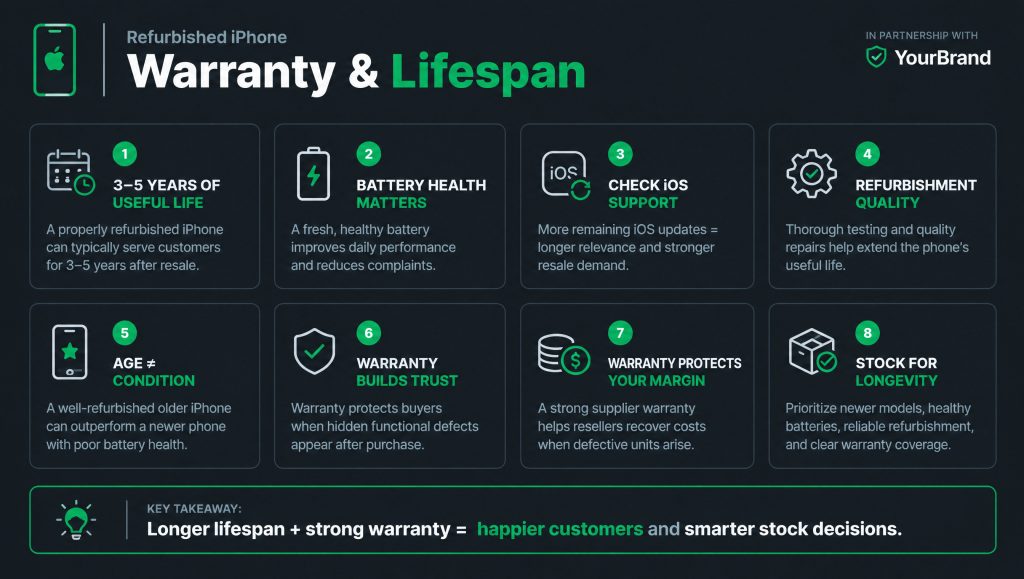
For your customers, warranty is proof that someone stands behind the phone. It turns “this might be fine” into “if something goes wrong, I am covered.” That shift in confidence directly affects willingness to pay. A refurbished iPhone with a clear warranty sells at a higher price and generates fewer pre-sale objections than the same phone with no cover.
For you as the reseller, your supplier’s warranty is what protects your margin when a defect slips through. If a unit fails within the warranty period, you resolve it with your customer and claim against your supplier. A supplier with a strong warranty and a fast claims process means a defective unit costs you time, not money. A supplier with no warranty or a slow process means every defect is a full loss.
At Remobile, Grade A and Grade B iPhones ship with a full warranty covering functional defects, and Grade C units carry a limited warranty. Each device includes a warranty card, and B2B partners get dedicated after-sales support with a streamlined returns process. That structure means when something does go wrong, and with any volume it occasionally will, the resolution is fast and the cost stays on our side, not yours.
What this means for your stock decisions
Lifespan and warranty are not abstract concepts. They translate directly into three practical rules for how you buy and what you sell.
First, stock models with the most remaining useful life. That means prioritizing models with several years of iOS support ahead and avoiding models near the end of their update window unless your market specifically demands budget stock and you price accordingly.
Second, prioritize suppliers who reset the battery. Battery health is the single biggest factor in how long your customer’s phone lasts and how they feel about it a year later. A supplier that puts a new battery in every unit removes the variable that causes the most complaints and gives your customers the longest possible experience from day one.
Third, use warranty as a selling tool. A visible, clearly stated warranty tells your buyer that the phone is backed and that you stand behind what you sell. It justifies a higher price, reduces hesitation, and builds the trust that brings customers back. The cost of offering warranty is low. The cost of not offering it, measured in lost sales, complaints, and one-time buyers who never return, is much higher.
FAQ
Does a refurbished iPhone last as long as a new one? In terms of hardware and daily performance, yes. A properly refurbished iPhone with a fresh battery performs identically to new. The difference is that some of the model’s total lifespan has already been used, so there are fewer remaining years of iOS support. A well-chosen model with strong battery health will give your customer 3 to 5 years of reliable everyday use.
What is the biggest factor in how long a refurbished iPhone lasts? Battery health at the point of sale. A phone with a new battery will last significantly longer in daily use than one with a degraded battery, regardless of the model. This is why sourcing from a supplier that installs new batteries is one of the most effective ways to ensure customer satisfaction.
Should I avoid stocking older models because of lifespan concerns? Not necessarily. Older models like the iPhone 13 still offer 3+ years of reliable use and appeal to price-sensitive buyers. The key is knowing where each model stands on iOS support and pricing it to match the remaining life. What you should avoid is stocking models that are about to lose iOS updates without discounting them appropriately.
How does warranty affect resale price? A refurbished iPhone listed with a clear warranty consistently sells at a higher price than the same phone with no warranty. Buyers are paying for confidence as much as the device. Even a modest warranty lifts perceived value and reduces the friction that causes a buyer to walk away.
Can a refurbished iPhone outlast its warranty period? Absolutely. Warranty covers the early window where hidden defects are most likely to appear. After that, the phone’s own build quality and battery health carry it forward. Most well-refurbished iPhones far outlast their warranty period, which is exactly what you want for customer satisfaction and repeat business.
Conclusion
A refurbished iPhone lasts as long as its battery, its remaining iOS support, and the quality of its refurbishment allow. For a reseller, knowing those three things about every unit you stock is what separates confident pricing from guesswork. Stock models with life ahead of them, source from a supplier that resets the battery and backs the phone with a real warranty, and your customers get a phone that lasts. For refurbished iPhones with a new battery on every unit, full grading traceability, and a warranty your business can rely on, explore our range at remobile.ae.