White labeling lets you sell a proven product under your own brand without manufacturing anything yourself. In refurbished electronics, that means buying certified refurbished iPhones from a supplier, having them packaged under your branding, and selling them as your own product line. Your customer sees your name, your box, and your warranty card. The supplier stays invisible.
It is one of the lowest-risk ways to build a brand in electronics. You skip the factory, skip the R&D, and start with a product that already has massive demand. This guide explains how white labeling works, why refurbished iPhones are one of the best products to white label, and how to start.
What is white labeling?
White labeling is a business model where one company makes the product and another company brands and sells it. The buyer never knows the original manufacturer was involved. The product carries your name, your packaging, and your identity.
In electronics, white labeling usually means one of two things. Either a manufacturer builds new devices that a brand puts its logo on, or a refurbisher restores devices to certified condition and packages them under a partner’s branding. The second version is what matters for refurbished iPhones, and it is simpler, cheaper, and faster to start than manufacturing.
You are not pretending you made the iPhone. Everyone knows iPhones come from Apple. What you are building is a retail brand that is known for selling quality refurbished iPhones with your own packaging, your own grading promise, your own warranty, and your own customer experience. The product inside the box is a certified refurbished iPhone. Everything around it is yours.
How white labeling works in refurbished electronics?
The process is straightforward once you have a supplier who offers white-label packaging. Here is how it works step by step.
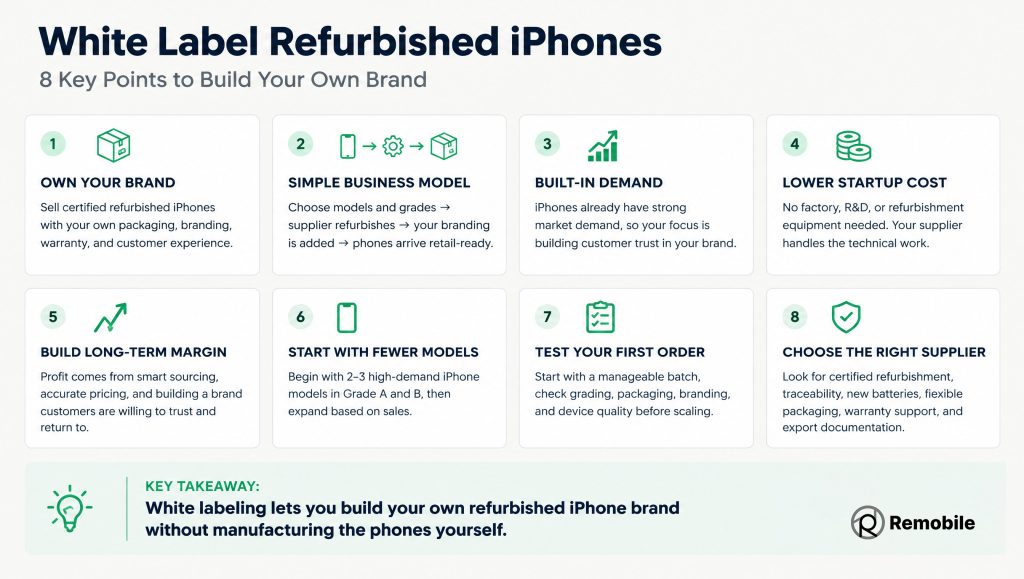
You choose the iPhone models, storage sizes, and grades you want to carry. Your supplier refurbishes each device through a certified process: inspection, repair, testing, new battery, grading. Once the phones pass quality checks, they are packaged in boxes carrying your branding instead of the supplier’s. Your logo, your color scheme, your warranty card, and your documentation go into the box. The phones ship to you retail-ready, looking like they came from your own operation.
When your customer opens the box, they see your brand. The unboxing experience, the printed materials, and the presentation are all yours. The quality of the device inside is backed by the supplier’s refurbishment standards, but the face of the business is yours.
This model works for online stores, physical retail shops, marketplace sellers, and B2B distributors. Whether you are selling ten phones a week from your own website or supplying a chain of stores with branded inventory, white labeling gives you the product without the production.
Why refurbished iPhones are one of the best products to white label?
Not every product makes sense to white label. The best white label products have high demand, strong margins, and a market where branding adds real value. Refurbished iPhones check all three.
Demand is built in. You do not need to explain what an iPhone is or convince anyone to want one. Hundreds of millions of people already use iPhones, and a significant portion of them are open to buying refurbished if the quality and trust are there. Your job is to be the brand they trust, not to create demand from scratch.
No manufacturing cost or risk. Building electronics from scratch requires factories, tooling, engineering, certifications, and enormous capital. White labeling refurbished iPhones requires none of that. Your supplier handles the refurbishment, testing, and certification. You handle the brand and the customer.
Margins are healthy. Refurbished iPhones carry strong margins for retailers, typically 15 to 30 percent net depending on the model, grade, and channel. When you add your own brand to the product, you build perceived value over time, which supports premium pricing that a generic listing cannot command.
The sustainability angle is genuine. Extending the life of an existing iPhone instead of manufacturing a new device is a real environmental benefit. Each refurbished iPhone keeps a working device out of a landfill and saves an estimated 80kg of CO2. For a growing number of buyers, that matters and it gives your brand a story that resonates.
The barrier to entry is low. You do not need a warehouse full of equipment or a team of engineers. You need a reliable supplier, a brand identity, and a sales channel. That makes this one of the most accessible white label businesses in electronics.
Is white labeling profitable?
Yes. White labeling refurbished iPhones is profitable when your sourcing is right and your brand adds value.
Your cost per unit is the wholesale price from your supplier plus the white-label packaging fee. Your revenue is whatever the market will pay for a branded, certified refurbished iPhone. The gap between those two numbers, minus your operating costs, is your margin.
In the short term, your margin is driven by sourcing well and pricing accurately. The math is the same as any reselling business. In the long term, the real profit comes from the brand itself. A customer who trusts your brand will pay more than they would for the same phone from a generic seller, come back for their next phone, and recommend you to others. That brand equity compounds over time and is what separates white labeling from simple reselling.
The most profitable white label operations focus on consistency. Same quality every time, same packaging experience, same warranty, same customer service. That consistency is what builds the reputation that justifies premium pricing.
Is white labeling legal?
Yes. White labeling is a standard, legal business model used across industries from food to cosmetics to electronics. You are not misrepresenting the product. You are buying a legitimate, certified product from a licensed supplier and selling it under your own retail brand with the supplier’s knowledge and agreement.
The line is clear: white labeling is legal, counterfeiting is not. You are not putting your logo on a fake product or claiming you manufactured something you did not. You are branding the retail experience around a genuine, certified refurbished iPhone. Your supplier knows their product is being repackaged. The arrangement is commercial and transparent.
Two things to get right. First, make sure your supplier agreement explicitly allows white-label rebranding. Any professional supplier offering white-label packaging has this built in. Second, do not misrepresent the product to your customer. A refurbished iPhone sold under your brand should be described as refurbished, with the grade and condition clearly stated. Honesty protects your brand and keeps you on the right side of consumer protection law in any market.
How to start a white label refurbished iPhone business?
Starting is simpler than most people expect. The complexity lives in doing it well, not in getting off the ground.
Find a supplier with white-label capability
This is the foundation. Your supplier determines the quality of your product, the consistency of your brand experience, and your ability to scale. Look for a supplier that offers certified refurbishment with documented standards, per-unit data on every device (IMEI, model, grade, battery health), custom packaging and branding from a manageable minimum order, a clear warranty that you can pass through to your customers, and global shipping with full export documentation.
At Remobile, white-label packaging is available from 100 units. Every iPhone goes through a 52-point inspection, ships with a new battery at 100 percent health, and comes with a unique certificate and full traceability from intake to final grade. Your branding, documentation, and retail-ready packaging are applied at our facility in Dubai before the phones ship, so they arrive ready to sell under your name.
Define your product range and brand
Decide which iPhone models and grades you want to carry. You do not need to stock every model on day one. Start with two or three high-demand models in Grade A and Grade B, and expand once you know what your market responds to.
Build a brand identity that fits your market. A clean logo, consistent packaging design, and a clear brand promise go a long way. Your brand does not need to be flashy. It needs to be trustworthy. Customers buying refurbished iPhones are looking for reliability and value, so your branding should communicate exactly that.
Place your first order
Start with a manageable quantity. A first order of 100 to 200 units across a few models and grades gives you enough stock to test the market without overcommitting capital. Inspect what arrives: confirm the grading matches, check the packaging, verify that your branding looks right, and test a sample of the devices.
Your first order is a proof of concept. Treat it as a learning batch. Track what sells, how fast, and whether the customer experience matches what you promised.
Build your sales channel
White label refurbished iPhones can sell through multiple channels. An online store gives you full control over branding and margins. Marketplaces give you reach but take a fee and limit how much branding you can show. Physical retail stores let customers see and hold the product. B2B distribution lets you supply other retailers with your branded stock.
Start with one channel, get it working, and add others as your volume grows. The white-label model scales naturally because your supplier handles the refurbishment and packaging. Your job is to sell and serve the customer.
What to look for in a white label supplier
Not every refurbishment supplier offers white labeling, and not every white-label offering is equal. Here is what separates a supplier you can build a brand on from one that will create problems.
A certified refurbishment process with documented standards. If the quality is inconsistent, your brand takes the hit, not the supplier’s. Look for a multi-point inspection, a defined grading rubric, and a zero-tolerance policy for defects.
Per-unit traceability. Every device should carry a unique identifier that links back to its full inspection and repair history. If a customer has a problem, you need to trace it back to the source.
New battery on every unit. Battery complaints are the fastest way to damage a new brand. A supplier that ships with original, degraded batteries is leaving the biggest customer-satisfaction variable unresolved.
Flexible packaging options. Your supplier should be able to apply your logo, include your warranty card and documentation, and package the phone in a retail-ready box that matches your brand’s look. Ask to see samples before committing.
Warranty support you can rely on. Your brand is making a promise to the customer. Your supplier’s warranty is what lets you keep that promise. Clear terms, a fast claims process, and dedicated B2B support are non-negotiable.
Export documentation and compliance. If you are buying internationally, your supplier should handle customs paperwork, compliance certifications, and shipping logistics. You should not have to chase documentation on every order.
ReMobile checks every point on this list. Certified 52-point inspection, new battery on every unit, unique certificate with full traceability, custom white-label packaging from 100 units, full warranty on Grade A and B, dedicated B2B account management, and tracked global shipping from Dubai with complete export documentation. That is the infrastructure a brand is built on.
FAQ
What does white label mean in business?
White label means one company makes the product and another brands and sells it. The end customer sees only the selling company’s brand. In refurbished electronics, it means a refurbishment supplier restores and certifies the devices, then packages them under the reseller’s branding.
Is white labeling the same as reselling?
Not quite. Reselling means buying a product and selling it as-is, often under the original brand or with no branding at all. White labeling means buying a product and selling it under your own brand, with your own packaging and identity. The difference is brand ownership and the customer relationship that comes with it.
How much does it cost to start a white label refurbished iPhone business?
Your main costs are the wholesale stock, the white-label packaging fee, and your sales channel setup. With minimum orders starting at 100 units, the initial investment depends on the models and grades you choose. There is no factory cost, no tooling, and no R&D, which makes it significantly cheaper than manufacturing.
Can I white label just the packaging, or do I need to modify the phone?
Just the packaging. The phone inside is a certified refurbished iPhone, and modifying Apple hardware would create legal and quality issues. White labeling in this context means your branding goes on the box, the warranty card, the documentation, and the retail presentation, not on the device itself.
What are the advantages of white labeling over starting from scratch?
Lower startup cost, faster time to market, no manufacturing risk, and you start with a product that already has proven demand. The trade-off is that you do not control the product itself, which is why choosing the right supplier matters so much. Your supplier’s quality is your brand’s quality.
Conclusion
White labeling refurbished iPhones lets you build a brand in electronics without building a factory. The product already has demand. The refurbishment and certification are handled by your supplier. Your job is to create the brand, the experience, and the customer trust that turns certified refurbished stock into your own product line. For white-label refurbished iPhones with a 52-point inspection, new battery on every unit, and custom packaging from 100 units, explore our B2B partnership at remobile.ae.