
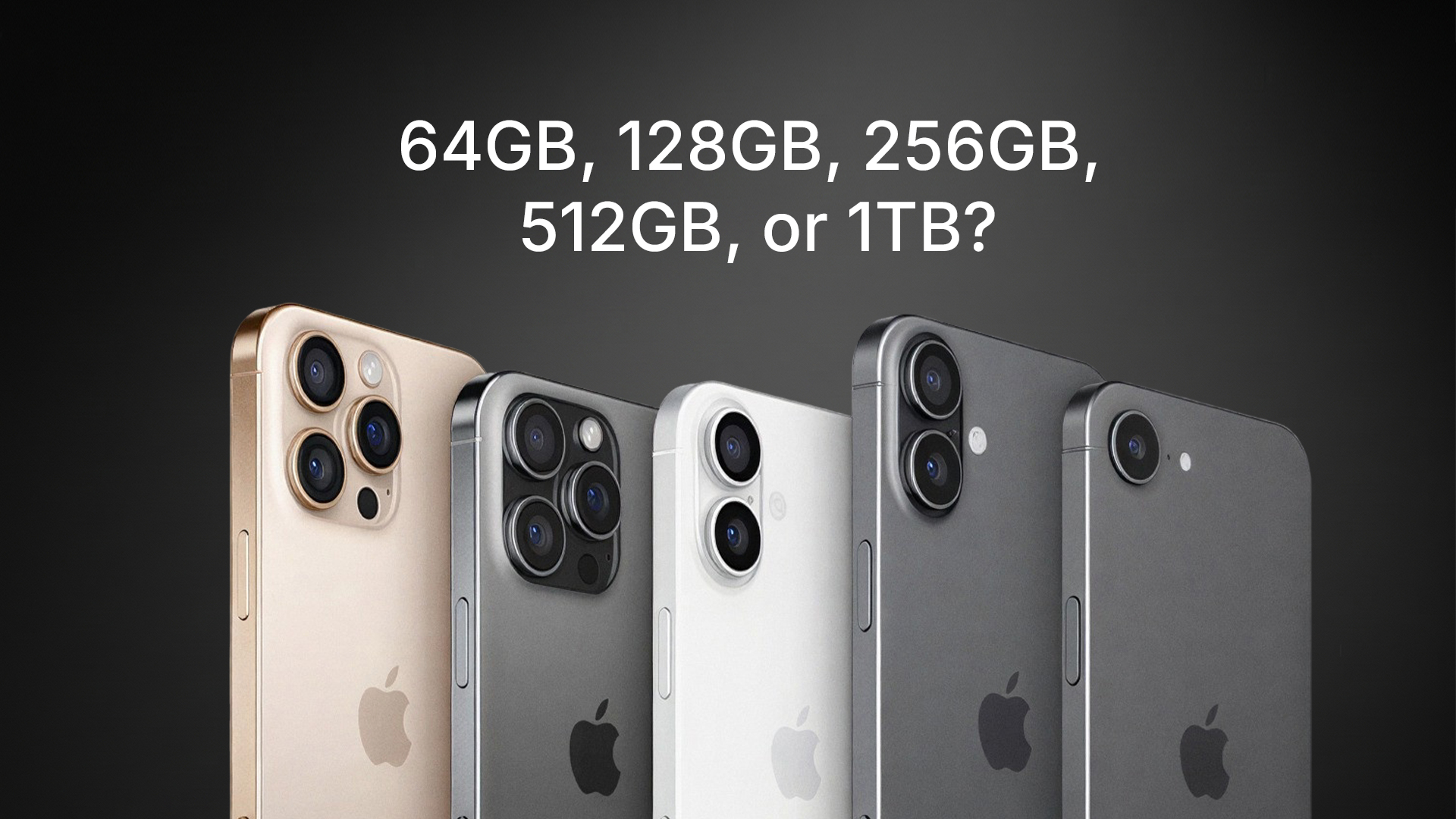
Storage size is one of the biggest pricing variables in refurbished iPhones. Two identical models in the same grade with the same battery health can sit $50 to $150 apart based on storage alone. Stock the wrong sizes and you tie up capital in units that sit. Stock the right ones and they move before you have to think about discounting.
This guide covers every storage size you will encounter in refurbished iPhone inventory from the iPhone 11 onward, which sizes sell fastest, which deliver the best margin, and how to build a storage mix that matches your market.
Every storage size from iPhone 11 onward
Apple has offered six storage tiers across the iPhone generations a reseller stocks today. Not every model comes in every size, so knowing which sizes exist on which models helps you source accurately and avoid surprises.
- 64GB: iPhone 11, iPhone 12, iPhone 12 mini, iPhone SE 2nd generation, iPhone SE 3rd generation. This was the base storage until the iPhone 13 generation moved the floor to 128GB.
- 128GB: iPhone 11 Pro and Pro Max, iPhone 12 Pro and Pro Max, and the base configuration for every standard and Pro model from iPhone 13 through iPhone 16. The most common size in the refurbished market by far.
- 256GB: Available across nearly every model from iPhone 11 onward. The mid-tier option on most generations and the new base storage starting with the iPhone 17 and all current Pro models.
- 512GB: Available on standard models from iPhone 13 onward and on Pro models from iPhone 13 Pro onward. Also on the iPhone 16e. The first step into premium storage territory.
- 1TB: Pro models only, starting with the iPhone 13 Pro. Also available on the iPhone Air and iPhone 17 Pro and Pro Max. The ultra-premium tier.
- 2TB: iPhone 17 Pro Max only. The newest and highest storage tier Apple has offered on an iPhone.
The trend across generations is clear. Apple keeps raising the floor. Base storage moved from 64GB to 128GB with the iPhone 13, and from 128GB to 256GB with the iPhone 17. Each step up makes the older, smaller sizes feel increasingly tight, which directly affects how fast they sell and what buyers will pay.
64GB
64GB is the storage tier that is slowly leaving the refurbished market. It was the base option on the iPhone 11, iPhone 12, iPhone 12 mini, and both the SE 2nd and 3rd generation. On those models, 64GB was perfectly fine when the phone was new. Today, it is getting tight.
iOS itself, built-in apps, and system data now consume a larger share of 64GB than they did at launch. A buyer who installs a handful of apps, takes photos regularly, and downloads some music or podcasts can find themselves managing storage within a few months. That friction is what kills demand. Buyers increasingly skip 64GB listings when a 128GB option is available at a modest premium.
For resellers, 64GB stock still sells, but it moves slower than 128GB on the same model and at a disproportionately lower price. The gap between what you pay for a 64GB unit and what you sell it for is often thinner than you would expect because the resale ceiling is held down by buyer reluctance.
The practical advice: if you are sourcing models that came in 64GB, prefer the 128GB or 256GB configurations. Stock 64GB only when the sourcing cost is low enough that the margin still works at the lower resale price, or when your market is strongly price-driven and your buyers will accept the trade-off. On the iPhone 12 and 12 mini specifically, 64GB can still work as the cheapest possible entry point to a modern iPhone, but position it that way honestly.
128GB
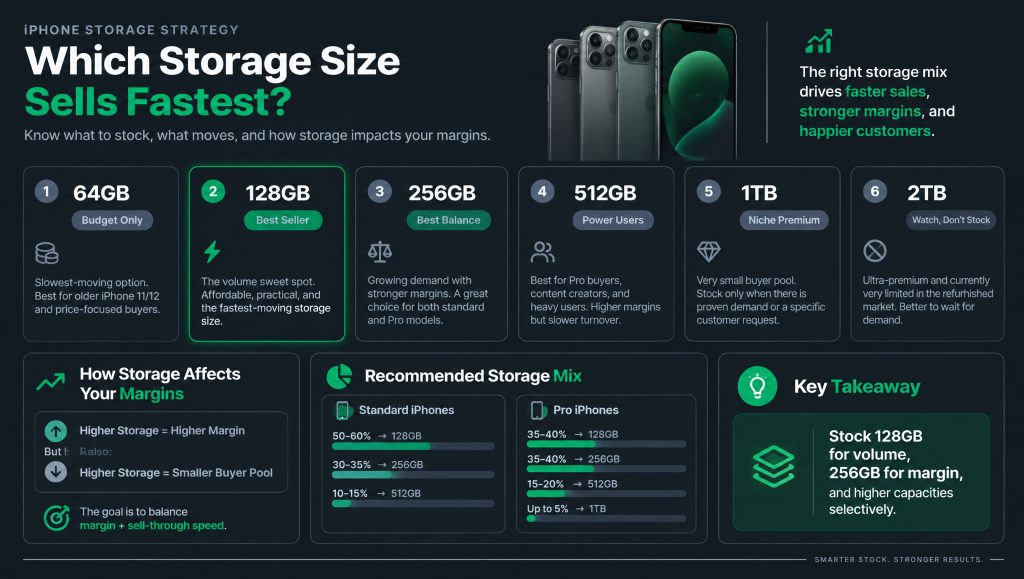
128GB is the volume sweet spot in the refurbished iPhone market. It is the base storage on every standard and Pro model from the iPhone 13 through the iPhone 16, which means it is the most common configuration in refurbished supply. More importantly, it is the size most buyers consider the default.
For everyday use, 128GB handles apps, photos, streaming, and casual video without the buyer ever thinking about storage management. It does not feel tight the way 64GB increasingly does, and it does not carry the price premium of 256GB. That middle ground is why it moves fastest.
Sell-through speed on 128GB across Grade A and Grade B is consistently the highest of any configuration. The buyer pool is the widest because 128GB is enough for nearly everyone who is not a heavy photographer, videographer, or gamer. Margins are moderate: the sourcing cost is the lowest for the base config on any model, and the resale price is strong because demand is reliable.
Stock 128GB as the deepest part of your inventory on any model from iPhone 13 through iPhone 16. If you are stocking iPhone 11 or 12, the equivalent volume play is 128GB where it was available or 64GB as the budget fallback.
One thing to watch going forward: the iPhone 17 moved the base to 256GB. As more buyers become accustomed to 256GB as the new starting point, the perception of 128GB will gradually shift from “plenty” to “entry level.” That shift is not urgent today, but it is coming, and it will eventually soften demand for 128GB on older models. For now, 128GB remains king.
256GB
256GB is where the refurbished market is heading. It is already the base storage on the iPhone 17, the iPhone Air, and all current Pro models. For buyers purchasing refurbished models from the iPhone 13 through 16 range, 256GB is the upgrade configuration that commands a meaningful price premium without feeling excessive.
Demand for 256GB has been growing steadily. As apps get larger, camera files get bigger (particularly with 48MP sensors on the iPhone 14 Pro and newer), and buyers keep more content on-device, 256GB is becoming the size that feels comfortable rather than generous. Buyers who are even slightly tech-aware often look for 256GB specifically, especially on Pro models where they plan to shoot a lot of photos and video.
For resellers, 256GB delivers the best margin-to-turnover ratio after 128GB. The sourcing cost is higher than 128GB, but the resale premium more than compensates. On many models, the absolute dollar margin on a 256GB unit is higher than on the 128GB version of the same phone, because the price jump to the buyer is larger than the cost jump to you.
Stock 256GB as your second-deepest configuration after 128GB. On Pro models, 256GB should arguably be your primary stock because Pro buyers tend to want more storage and the base Pro from the iPhone 16 generation already starts at 256GB.
512GB
512GB is the power user tier. It is available on standard models from the iPhone 13 onward and on every Pro model in the same range, plus the iPhone 16e. Buyers who choose 512GB usually have a specific reason: they shoot a lot of video, carry large music or podcast libraries, or use their phone as a primary device for content creation.
The buyer pool is smaller than 128GB or 256GB, which means sell-through is slower. But the per-unit margin is strong because the price premium over 256GB is significant while the sourcing cost increase is more modest. Each 512GB sale contributes meaningfully to your bottom line.
Where 512GB moves best is on Pro models. A customer buying a refurbished iPhone 15 Pro or 16 Pro is more likely to want 512GB than a customer buying a standard iPhone 15, because the Pro’s camera system generates larger files and the buyer profile skews toward heavier usage. On standard models, 512GB is a harder sell because the buyer who chose the standard tier is usually more price-conscious and less likely to pay the storage premium.
Stock 512GB in small quantities, concentrated on Pro models. A few units per order is enough for most markets. If they sell quickly, increase the share on your next order. If they sit longer than your 256GB stock, you have your answer.
1TB
1TB is available on Pro models only, starting with the iPhone 13 Pro and continuing through the iPhone 16 Pro and Pro Max. It also appears on the iPhone Air and iPhone 17 Pro and Pro Max. On the refurbished market, 1TB units are rare and expensive.
Very few buyers need 1TB on a phone. Professional videographers, photographers who shoot in ProRAW, and users who want to keep their entire media library on-device are the audience. Everyone else looks at the price and picks a smaller size.
For resellers, 1TB is a niche within a niche. The per-unit margin is the highest in the lineup because the price premium over 512GB is steep. But turnover is the slowest of any storage tier. A 1TB unit can sit in your inventory for weeks longer than a 256GB unit of the same model, and every week it sits, it ties up capital and risks depreciation.
Stock 1TB only on specific demand. If a customer asks for it, source it. If your market has a proven premium segment that buys Pro Max at full spec, carry one or two. Otherwise, skip it and put that capital into 256GB and 512GB units that will turn faster.
2TB
2TB exists on the iPhone 17 Pro Max only and is the newest storage tier Apple has introduced on an iPhone. It is not yet a factor in the refurbished market because the iPhone 17 series is still very early in its refurbished cycle, with thin supply and modest discounts over new.
When 2TB refurbished units do become available in meaningful volume, expect the same pattern as 1TB: highest price, highest per-unit margin, slowest sell-through, very narrow buyer pool. This is a tier to watch rather than a tier to stock proactively.
How storage affects your pricing and margins
Storage creates pricing tiers within the same model, and those tiers behave differently in the refurbished market than they did at retail. Understanding the pattern helps you price accurately.
At retail, Apple charges a flat premium for each storage step up. The jump from 128GB to 256GB on a new iPhone 16 is $100, and from 256GB to 512GB is another $100 to $200. In the refurbished market, those gaps compress. The percentage premium for higher storage shrinks as the base price drops, because buyers anchor to absolute dollar amounts rather than percentages.
What this means in practice is that higher storage configurations often carry a better margin ratio on refurbished than they do on new. A 256GB iPhone 15 might cost you $30 to $40 more to source than a 128GB, but you can sell it for $50 to $70 more. That gap is your advantage on the upgrade configuration.
The flip side is turnover. The higher the storage, the smaller the buyer pool and the slower the sale. Your total profit over a quarter might be higher on ten 128GB units that turned in two weeks each than on five 256GB units that took a month each, even though the per-unit margin on the 256GB was better.
The smart play is a mix. Stock your volume in 128GB for fast turns and healthy cash flow. Stock 256GB for stronger per-unit margins on your second-most-popular configuration. Add small quantities of 512GB on Pro models for premium buyers. And treat 1TB as made-to-order rather than speculative stock.
Stocking the right storage mix
Here is a practical starting ratio for a general market. Adjust based on your sell-through data.
For standard models (iPhone 13 through 16): stock roughly 50 to 60 percent in 128GB, 30 to 35 percent in 256GB, and 10 to 15 percent in 512GB. Skip 64GB unless you are specifically serving a budget market with iPhone 11 or 12 stock.
For Pro models: shift the balance toward higher storage. Stock roughly 35 to 40 percent in 128GB (where available as base), 35 to 40 percent in 256GB, 15 to 20 percent in 512GB, and 5 percent or less in 1TB.
For budget models (iPhone 11, 12, SE): 128GB should be your primary if available. 64GB works as the entry point if sourced cheaply. 256GB is rarely worth stocking on these older models because the resale premium is hard to justify on an aging device.
Track which sizes sell fastest and adjust with every order. The right mix is not the same for every market, and it shifts over time as buyer expectations move upward.
FAQ
Which storage size has the best margin for resellers?
256GB typically delivers the best margin ratio. The sourcing cost premium over 128GB is modest, but the resale premium is proportionally larger. On Pro models, 512GB can also deliver strong per-unit margins, though it turns more slowly.
Is 64GB still worth stocking?
Only on iPhone 11 and 12 models where it was the base configuration, and only when the sourcing cost is low enough that the thinner resale margin still works. On any model where 128GB is available, buyers will almost always choose the larger size.
Should I stock 1TB units?
Only on specific demand or if your market has a proven premium buyer base. 1TB ties up the most capital per unit and turns the slowest. The margin per sale is high, but the opportunity cost of that capital sitting in slow stock can outweigh it.
Will 128GB become the new 64GB?
Eventually, yes. The iPhone 17 already starts at 256GB, and as more buyers use that as their reference point, 128GB will gradually be perceived as the minimum rather than the standard. That shift will take a year or two to fully affect the refurbished market for iPhone 13 through 16 models, but it is the direction things are moving.
Does storage size affect return rates?
Rarely directly. Returns related to storage happen when a buyer realizes 64GB is too tight after setup, which is an expectation issue. Listing the storage size clearly and noting that 64GB may feel limited prevents most of these. On 128GB and above, storage is almost never a reason for return.
Conclusion
128GB is the volume backbone of the refurbished market today, 256GB is the growing mainstream that delivers the best per-unit margin, and everything above 512GB is niche stock for proven demand. Build your orders around 128GB and 256GB, add small quantities of 512GB on Pro models, and let your sales data tell you when to go higher. For refurbished iPhones across every storage configuration with verified grading, new battery, and full manifest data, explore our range at remobile.ae.