
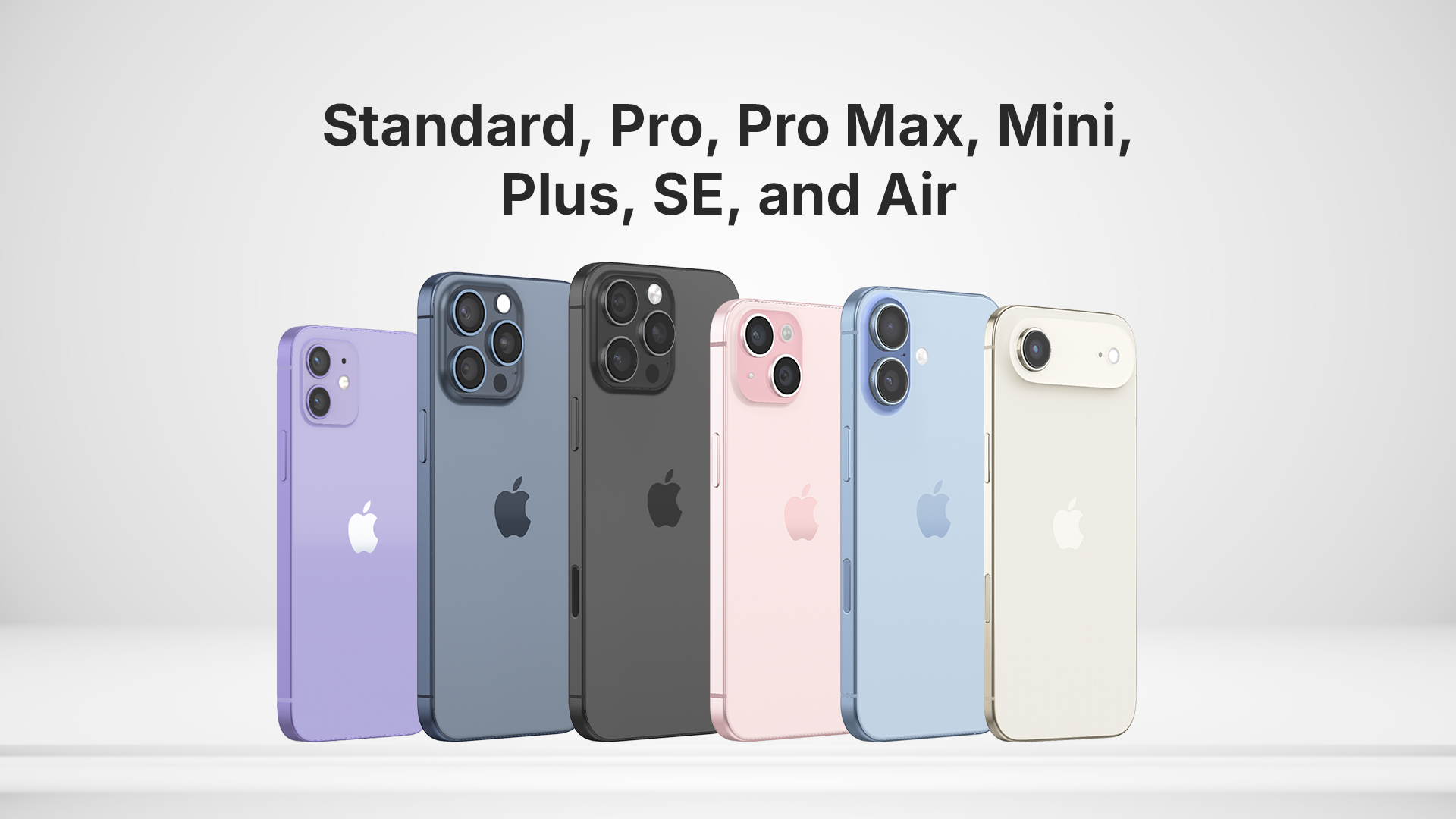
Apple has sold iPhones across seven distinct tiers over the past several years. As a reseller stocking refurbished inventory, you will encounter all of them. Each tier targets a different buyer, carries a different margin profile, and moves at a different speed. Knowing the full map helps you build a stock mix that covers your market without tying up capital in tiers that sit.
This guide covers every iPhone tier a reseller will see in refurbished stock today: Standard, Pro, Pro Max, Mini, Plus, SE and the newer “e” series, and Air. For each one, you get the key differences, who buys it, and whether it deserves space in your inventory.
iPhone Full Tier Map
Here is the quick overview before we go deeper. Every tier that exists or has existed in the generations a reseller stocks today:
- Standard (iPhone 11 through 17): the core iPhone. Broadest appeal, highest volume.
- Pro (iPhone 11 Pro through 17 Pro): premium camera, ProMotion display, stronger chip. The margin tier.
- Pro Max (iPhone 11 Pro Max through 17 Pro Max): everything the Pro has in the biggest body. Best battery, highest price.
- Mini (iPhone 12 mini, 13 mini): the compact iPhone. Discontinued after 2021, available refurbished only.
- Plus (iPhone 14 Plus, 15 Plus, 16 Plus): bigger standard iPhone, no Pro features. Discontinued with iPhone 17, replaced by Air.
- SE / “e” series (iPhone SE 2nd gen, SE 3rd gen, iPhone 16e, iPhone 17e): the budget tier. Cheapest new iPhone at any given time.
- Air (iPhone Air): the thin and light tier. Launched September 2025, just entering the refurbished market.
Not every generation includes every tier. The Mini existed for only two generations. The Plus lasted three. The Air is brand new. But all of them show up in refurbished inventory, and knowing what each one is helps you price and position every unit you stock.
Standard
The standard iPhone is the foundation of the refurbished market. More units of the standard tier are bought, refurbished, and resold than any other tier, and for good reason. It is the iPhone that does everything most people need at the most accessible price.
Every standard iPhone gets the same iOS updates as the Pro, runs the same apps, supports the same ecosystem features like AirDrop, MagSafe, and Find My, and takes very good photos. What it does not have is the Pro’s telephoto camera, ProMotion display, or always-on screen. For the vast majority of buyers, those omissions do not matter.
For resellers, the standard tier is the volume backbone. It sources at the lowest cost per unit among the full-size tiers, turns the fastest, and covers the widest buyer pool. The margin per unit is moderate, not as high as the Pro, but the turnover makes up for it. If you could only stock one tier, this would be it.
The main thing to watch is depreciation. Standard models lose value faster than Pro models, especially after a new generation launches. Turn this stock quickly and do not overhold.
Pro
The Pro is where the money is on a per-unit basis. It costs more to source, sells at a higher price, and the gap between those two numbers is wider than on the standard tier.
Three things separate the Pro from the standard and matter to buyers. The camera system adds a telephoto lens with optical zoom, better low-light performance, and professional video features like ProRes recording. The display runs at 120Hz with ProMotion, which makes everything on screen feel faster and smoother, and it includes an always-on mode. The chip is the Pro variant of Apple’s silicon, which on the iPhone 15 generation is the dividing line for Apple Intelligence support.
Who buys the Pro refurbished
Photography enthusiasts, power users, and buyers who want the best without paying full new price. These customers tend to be more informed, less price-sensitive within the refurbished range, and less likely to return the phone. They know what the Pro offers and they are buying it for specific reasons.
How it moves
Steadily. The Pro does not spike and crash the way budget stock can. Demand is consistent across seasons because the buyer profile is stable. Pro models also hold their resale value better than any other tier, which means your inventory depreciates more slowly. You can afford to hold Pro stock a little longer than standard without losing margin to time.
Stock the Pro as your margin builder. It will not outsell the standard in volume, but each sale contributes more profit.
Pro Max
The Pro Max is the Pro in the biggest possible body. Same chip, same camera system in most generations, same ProMotion display, but with a larger 6.7 to 6.9 inch screen and the longest battery life of any iPhone. In certain generations, the Pro Max also carried an exclusive camera feature that the standard Pro did not, like the periscope telephoto on the iPhone 15 Pro Max.
For resellers, the Pro Max is a niche play. It sells fewer units than the Pro because fewer buyers want a phone this large and this expensive, even at refurbished prices. But each unit that sells delivers the highest per-unit margin in the lineup.
The buyer profile is specific: people who want the biggest screen, the best battery, and the most premium iPhone available. They are rarely impulse buyers. They usually know they want the Max before they start shopping. Returns are very low because expectations are clear.
Stock the Pro Max in smaller quantities than the Pro. A ratio of roughly one Max for every two or three Pro units works for most markets. If your customer base skews toward premium buyers or markets where big screens are strongly preferred, increase the Max share.
Mini
The Mini is a compact iPhone with a 5.4-inch display that Apple sold in two generations: the iPhone 12 mini and the iPhone 13 mini. Apple discontinued the mini line after 2021 because sales were lower than other tiers. No new mini models will be made.
That discontinuation actually creates an opportunity for resellers. The Mini has a small but loyal buyer base: people who specifically want a compact phone that fits comfortably in one hand, in a pocket, or in a small bag. These buyers have no new option from Apple since every current iPhone is 6.1 inches or larger. Refurbished is the only way to get a mini, which gives the tier a supply-limited dynamic that can support solid pricing.
The iPhone 13 mini is the better of the two to stock. It has the A15 chip, still receives iOS updates, and will be supported for a few more years. The iPhone 12 mini is older and its battery at this age is often below the 80 percent threshold unless it has been replaced.
Stock the Mini in small quantities and market it specifically to compact-phone seekers. It is not a volume play and it is not for every market. But where it fits, it moves well and the competition from other resellers is often thinner because many skip this tier entirely.
Plus
The Plus is a bigger version of the standard iPhone. Larger screen, longer battery life, same camera, same chip, same 60Hz display. It does not have any Pro features. Apple sold the Plus from the iPhone 14 generation through the iPhone 16 generation, then discontinued it and introduced the Air in its place.
The Plus is the weakest tier in the refurbished market for most resellers. It sits in an uncomfortable position: more expensive than the standard but without the features that justify the Pro’s price. Buyers who want a bigger screen and are willing to pay more often look at the Pro, which costs only a little more and adds a telephoto camera, ProMotion display, and a better chip. Buyers who want value go standard. The Plus appeals to a narrow segment that wants bigger and nothing else.
Sell-through on refurbished Plus models is slower than both the standard and the Pro. Margins are compressed because the sourcing cost is higher than the standard but demand does not support proportionally higher pricing.
The honest advice is to stock the Plus lightly or skip it unless your sales data shows genuine local demand. The fact that Apple itself replaced the Plus with a completely different tier validates the positioning problem. If you have Plus units in inventory, price them competitively and move them rather than holding.
SE and the “e” series
Apple’s budget tier has gone through a name change but the purpose is the same: the cheapest new iPhone available at any given time.
The older models are the iPhone SE 2nd generation (launched 2020, uses the iPhone 8 body) and the iPhone SE 3rd generation (launched 2022, same body with a newer chip and 5G). Both are available refurbished. The newer models are the iPhone 16e (launched February 2025) and the iPhone 17e (launched March 2026), which dropped the “SE” name in favor of “e” and moved to a modern full-screen design with Face ID.
For resellers, this tier serves the most price-conscious buyers: first-time iPhone owners, parents buying for children, businesses outfitting staff with basic smartphones, and customers in markets where price is the primary driver. The phones are fully functional, run the latest iOS, and do everything a casual user needs.
What to watch
The older SE models with the iPhone 8 body are reaching the end of their useful life. The design looks dated, the screen is small with thick bezels, and iOS support will eventually end. The SE 2nd gen in particular is nearing the point where stocking it only makes sense at a very low price for a very specific market.
The iPhone 16e and 17e are much stronger products with modern design, Face ID, and the A18 chip (16e) or later. As these enter the refurbished market in greater volume, they will gradually replace the older SE models as the go-to budget option.
Margins on the budget tier are the thinnest in the lineup. The sourcing cost is low, but so is the resale ceiling. What this tier earns you is volume and foot traffic. A customer who buys an affordable refurbished iPhone from you today and has a good experience may come back for a Pro next time.
Air
The iPhone Air is Apple’s newest tier, launched in September 2025. It is the thinnest and lightest iPhone Apple has made, positioned as a premium option between the standard iPhone and the Pro. It uses the A19 Pro chip, has a 6.6-inch display, and launched at $999 new.
The Air is just beginning to enter the refurbished market in 2026, so data on how it moves is still early. What we do know is that the Air depreciated nearly 48 percent shortly after launch, one of the steepest drops in recent iPhone history. That rapid decline suggests the market found the price hard to justify given what the Air offers compared to the standard and Pro tiers.
For resellers, the Air is a wait-and-watch tier right now. The steep depreciation means sourcing costs could be attractive, but demand in the refurbished market is unproven. The Air does not have the Pro’s camera system, which is the feature most premium buyers upgrade for. It does not have the standard’s price advantage. Its selling point is thinness and lightness, which appeals to some buyers but is not the primary purchase driver for most.
Stock the Air only if you see clear demand signals in your market, and start with very small quantities. As refurbished supply grows and pricing settles, this tier may find its footing. But right now it is too early to commit significant capital.
Which tiers to stock and in what ratio
Your ideal mix depends on your market, but here is a practical starting framework that works for most refurbished iPhone resellers.
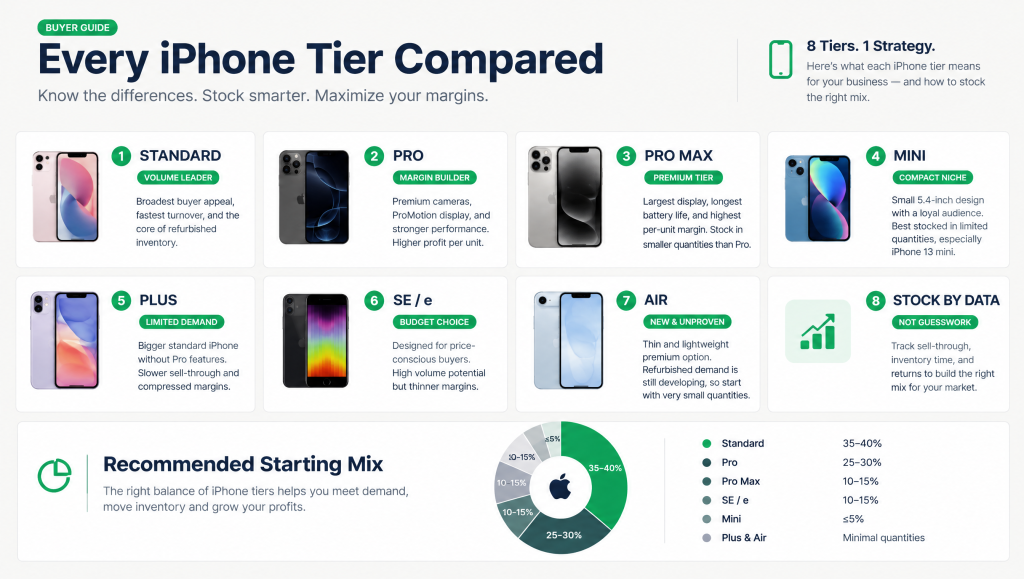
For a general market serving a mix of buyers, build your inventory roughly like this: Standard at 35 to 40 percent of your stock, Pro at 25 to 30 percent, Pro Max at 10 to 15 percent, SE/e at 10 to 15 percent, Mini at 5 percent or less, and Plus and Air at minimal quantities unless your data says otherwise.
For a budget-focused market, increase the standard and SE/e share and reduce the Pro and Max. For a premium market, increase Pro and Pro Max and reduce the budget tiers.
The ratio is not fixed. It is a starting point that you adjust based on sell-through data from your first few orders. Track which tiers move fastest, which sit longest, and which generate the most returns. Let your sales data lead your second and third orders, not assumptions.
At ReMobile, we supply refurbished iPhones across all tiers from iPhone 8 through the iPhone 16 series. Every unit goes through our 52-point inspection, ships with a new battery at 100 percent health, and carries a per-unit manifest with IMEI, model, storage, grade, and battery data. Whether you are building your volume on standard models or your margin on Pro stock, the quality and documentation are the same across every tier.
FAQ
Which iPhone tier sells the fastest refurbished? The standard tier, by a significant margin. It has the broadest appeal, the lowest price, and the widest buyer pool. The Pro is the fastest-moving premium tier.
Is the Mini still worth stocking? In small quantities, yes, if your market has buyers who want compact phones. Since Apple no longer makes a mini, refurbished is the only source, which limits supply and can support decent pricing. The iPhone 13 mini is the better choice over the 12 mini.
Should I avoid the Plus entirely? Not necessarily, but stock it lightly. The Plus moves slower than both the standard and the Pro in most markets. If you have Plus units, price them to move rather than holding. Apple discontinued the tier for a reason.
What is the difference between SE and the “e” series? Same purpose, new name. The iPhone SE was Apple’s budget tier through the 3rd generation (2022). Starting with the iPhone 16e (2025) and iPhone 17e (2026), Apple rebranded the budget line as “e” and moved to a modern full-screen design with Face ID. The “e” models are significantly better products than the older SE models.
Which tier holds its value the longest? Pro and Pro Max. Premium materials, better cameras, and the Apple Intelligence cutoff on the iPhone 15 generation all help Pro models depreciate more slowly than other tiers. Standard models lose value faster but source cheaper, so the margin can still work if you turn them quickly.
Conclusion
Seven tiers, seven different demand profiles, seven different margin stories. Build your inventory around the standard for volume and the Pro for margin, add the Max for premium buyers and the SE/e for budget markets, and handle the Mini, Plus, and Air carefully based on your own sales data. For certified refurbished iPhones across every tier with a 52-point inspection and new battery on every unit, explore our range at remobile.ae.