The iPhone 11 is seven years old, runs on a chip from 2019, and has been on the edge of losing iOS support for two years running. Most resellers have already written it off.
And yet Apple kept it alive. iOS 27, released in September 2026, still supports the iPhone 11, making it the oldest iPhone running the current operating system. Most predictions ahead of WWDC 2026 had the iPhone 11 on the chopping block, but Apple defied them, and the A13 Bionic now holds the record for the longest-supported iPhone chip in history at eight years and counting.
So the phone is technically current. But being technically current and being worth stocking are two different questions. This guide breaks down the full iPhone 11 family, who is still buying each variant, what happens when iOS 28 finally cuts it off, and how to stock it without getting stuck with inventory you cannot move.
The iPhone 11 in late 2026 and what Apple’s iOS 27 decision means
Apple’s choice to keep the iPhone 11 on iOS 27 was strategic, not charitable, and the reasoning tells you a lot about where the refurbished market sits right now.
The refurbished smartphone market has grown significantly in price-sensitive regions. Counterpoint Research data shows refurbished iPhone growth in Africa, India, and Southeast Asia driven by models like the iPhone 12, 13, and 14. But behind those models, the iPhone 11 remains the cheapest fully supported entry point to the Apple ecosystem. Dropping it from iOS 27 would have pushed millions of users toward Android at a time when Apple is under pressure from sub-$500 Android phones made by Samsung, Motorola, and Google.
A CNET survey of over 2,600 adults found that more than 48 percent had considered buying a refurbished device. People are keeping phones longer and accepting older hardware that meets their daily needs. Apple benefits from that behavior only if those older phones still run current software.
For resellers, this means the iPhone 11 has at least a few more months of confident selling. It runs the same iOS as the iPhone 17, apps work, and security patches still arrive. For a buyer who needs a working iPhone at the lowest possible price, the iPhone 11 checks the box. The question is how much longer that window stays open.
What the iPhone 11 can still do (and what it cannot)
The iPhone 11 is a capable phone for basic use, and an increasingly limited one for anything beyond that.
It runs iOS 27 smoothly enough for everyday tasks. Calls, messages, email, web browsing, social media, maps, and streaming all work without trouble. The A13 Bionic chip with 4GB of RAM handles current apps. The 6.1-inch Liquid Retina LCD is perfectly fine for reading and watching video. Battery life on a fresh battery is decent for a full day of light use, thanks to the 3,110 mAh cell.
The dual 12MP camera system includes Night Mode, which was a headline feature when the phone launched in 2019. Photos are good in daylight and acceptable in low light. For a buyer who posts to social media or takes casual photos, the camera does the job.
The limitations are where the phone’s age becomes obvious. The iPhone 11 is LTE only, with no 5G support, which means buyers in markets with strong 5G coverage are stuck on slower connection speeds, especially for video calls and streaming. It will never receive Apple Intelligence, the AI features Apple is marketing heavily across every new iPhone, because those require the A17 Pro chip at minimum. The phone still uses Lightning instead of USB-C and has no MagSafe support, which cuts it off from the magnetic charging accessories that increasingly define the iPhone ecosystem.
The 6.1-inch LCD screen is functional but looks noticeably less sharp and less vibrant when placed next to any iPhone 12 or newer with an OLED display. That side-by-side comparison is impossible to miss in a shop setting. Face ID works but uses the older TrueDepth system, which is slower than the versions in newer models.
These missing features do not stop the phone from working for everyday tasks, but they narrow the pool of buyers who will choose it over spending a little more on the iPhone 12 or 13.
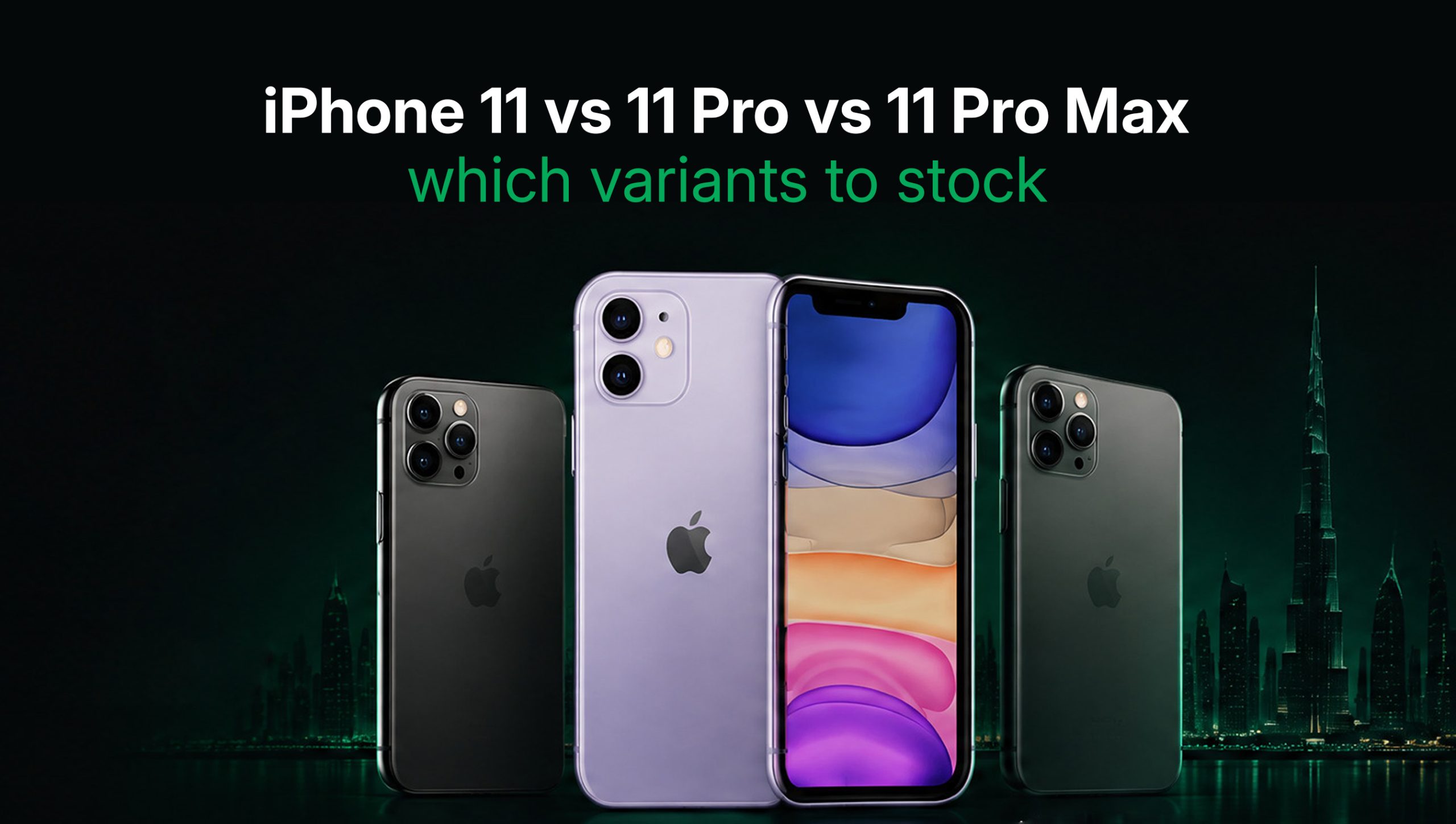
iPhone 11 vs 11 Pro vs 11 Pro Max: which variants to stock
The iPhone 11 family has three models, and they are not equally worth stocking. Each one serves a different buyer at a different margin, and the differences matter more now than they did when the phones were new.
iPhone 11
The standard iPhone 11 is the volume play. It is the cheapest of the three to source, the most available in the refurbished pipeline, and the easiest to sell at the budget price point where this generation lives.
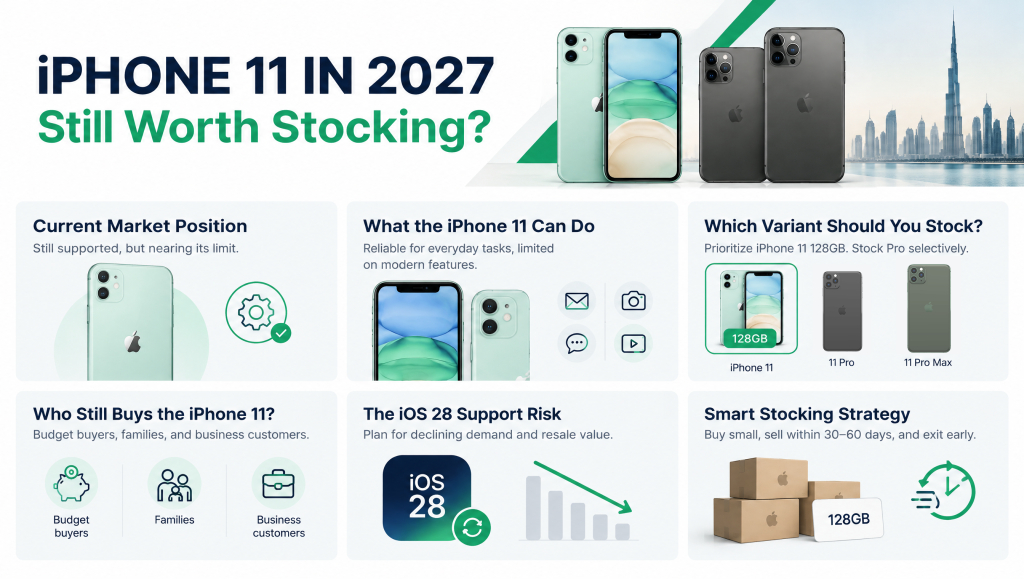
Storage options are 64GB, 128GB, and 256GB. Stock 128GB if you can. The 64GB base is tight for buyers in 2026 and 2027, and the 256GB carries a premium that is hard to justify when the phone itself is this old.
The dual camera with ultrawide and Night Mode gives buyers more than enough for everyday use. The 6.1-inch screen is the right size for most people. This is the model that moves in volume, and it is the one you should stock if you are only going to carry one variant.
iPhone 11 Pro
The 11 Pro adds a triple camera system with telephoto, an OLED Super Retina XDR display, and a stainless steel frame. It is a noticeably more premium phone in hand. For buyers who care about screen quality and camera versatility, the Pro is the pick over the standard 11.
The challenge is pricing. Refurbished 11 Pro units cost more to source, but the ceiling on what buyers will pay for a seven-year-old Pro model is not much higher than the standard. The margin per unit can be thinner than expected because the sourcing premium is not fully recoverable in the resale price. Stock it in small quantities for buyers who specifically ask for a Pro-level phone at the lowest possible price.
Storage options are 64GB, 256GB, and 512GB. The 256GB is the sweet spot here.
iPhone 11 Pro Max
The Pro Max has the same triple camera and OLED display as the Pro, plus a larger 6.5-inch screen and a bigger 3,969 mAh battery. It appeals to buyers who want the largest possible screen and the longest battery life at the lowest possible price.
Demand for the Pro Max is niche at this point. The buyers who want a large-screen iPhone at a budget price have mostly moved to the iPhone 12 or 13, where the screen technology and overall experience are significantly better. Stock the Pro Max only if you have specific demand for it. For most resellers, the standard iPhone 11 and a small allocation of the 11 Pro are enough.
The buyers who still want it
The iPhone 11 sells to a specific set of buyers, and understanding who they are tells you whether your market has enough of them to justify carrying the phone.
Budget-first buyers in emerging markets. In regions across Africa, the Middle East, South Asia, and Southeast Asia, the iPhone 11 is the entry point to Apple. These buyers are not comparing the iPhone 11 to the iPhone 15. They are comparing it to a mid-range Android phone at a similar price, and the iPhone wins on software support, ecosystem access, and perceived prestige. This is the largest remaining buyer segment for the iPhone 11 and the one that will sustain demand the longest.
Businesses buying fleet devices. Companies that need to hand out phones for communication, email, and basic apps do not need the latest hardware. They need something that works, runs current software, and costs as little as possible per unit. The iPhone 11 fits that brief at a price point that makes outfitting a team of 20 or 50 people affordable.
Parents buying for teenagers. A durable, fully functional iPhone with a large enough screen for a teenager, at a price that does not sting if the phone gets dropped or lost. The iPhone 11’s size, durability, and current iOS support make it a practical choice for parents who want to give their child an iPhone without spending $300 or more.
Buyers replacing a broken older iPhone. Someone whose iPhone 8 or X just broke and who wants a familiar Apple experience at the cheapest possible price will often land on the iPhone 11 as the natural step up. They are not shopping for features so much as shopping for continuity with the Apple ecosystem they already know.
If your customer base includes a meaningful share of any of these segments, the iPhone 11 still has a place in your inventory. But if your buyers tend to compare specs, screens, and cameras before making a decision, the iPhone 11 will sit on the shelf while newer models move past it.
The expiration date and planning for the iOS 28 cutoff
Apple kept the iPhone 11 on iOS 27, but there is almost no chance it survives the jump to iOS 28.
The A13 Bionic is already the oldest chip Apple supports. Keeping it for one more year would be unprecedented even by Apple’s newly extended standards. Every credible prediction for iOS 28, expected to be announced at WWDC in June 2027, includes the iPhone 11 on the drop list.
The pattern from every previous iOS cutoff shows exactly what to expect, and it plays out the same way every time.
The announcement comes first, usually in June, and the moment Apple confirms the iPhone 11 will not receive iOS 28, the resale value drops noticeably within weeks as buyers who were on the fence decide to spend a little more on a phone that will be supported for longer.
When the new iOS rolls out in September, buyers who already own the iPhone 11 start feeling left behind as new app features stop working and some apps begin requiring the newer iOS version. The phone still functions, but it starts to feel like a dead end to the people using it, which makes selling the same phone to new buyers much harder.
Within six months of losing support, the iPhone 11’s resale value will likely settle at a level that makes the margin barely worth the effort of selling it. Sourcing, inspecting, listing, shipping, and handling returns for a phone that sells for under $80 is a lot of work for very little return.
The practical timeline for resellers looks like this. Stock and sell confidently through winter 2026 and into early 2027. Start reducing orders by March 2027. Do not source new iPhone 11 inventory after May 2027 unless you can sell it within 30 days. By September 2027, clear any remaining stock at whatever the market will bear.
Holding iPhone 11 inventory past September 2027 means sitting on a depreciating asset with no price floor in sight, and the longer you hold it, the less each unit is worth.
Stocking rules for a phone at the end of its life
The iPhone 11 can still make you money, but only if you treat it like a phone with a known expiration date and follow a few rules that keep your risk low.
Keep quantities small and buy only what you can sell in 30 to 60 days, reordering only if the previous batch actually moved. The moment you are holding iPhone 11 units for more than two months, your capital is in the wrong place.
Focus on the standard model in 128GB. It is the cheapest to source, the easiest to sell, and the most liquid if you need to clear stock quickly. Carry the 11 Pro only in small numbers for specific demand.
Price it as a budget phone, not a discounted flagship. The iPhone 11 is not a premium phone on sale. It is a budget phone that happens to run the latest iOS. Position it that way and you attract the right buyer. Position it as a deal on a premium phone and you get returns from buyers who expected more.
Set expectations in every listing. State the grade, the battery health, the storage size, and the iOS support status clearly. A line like “runs iOS 27, expected to lose support with iOS 28 in late 2027” is honest and protects you from complaints later.
Have an exit plan before you place your first order, with a clear date by which you will stop ordering, a date by which you will start discounting remaining stock, and a date by which you will clear whatever is left at whatever the market will pay. The difference between a planned exit and an unplanned one is usually the difference between a small profit and a loss.
Source from a supplier that gives you a new battery on every unit. The iPhone 11’s original battery is seven years old. Even a well-preserved unit will have degraded significantly. A phone that arrives with 100 percent battery health, like every unit from ReMobile, removes the most common complaint about phones this age and reduces your return rate.
FAQ
Will the iPhone 11 get iOS 28? Almost certainly not. The A13 Bionic is the oldest chip Apple supports on iOS 27, and keeping it for another year would be without precedent. Expect the iPhone 11 to be dropped when iOS 28 is announced at WWDC in June 2027.
Is the iPhone 11 Pro worth stocking over the standard iPhone 11? For most resellers, no. The standard iPhone 11 is cheaper to source, easier to sell, and moves faster. The 11 Pro appeals to a smaller audience willing to pay slightly more for the OLED screen and triple camera, but the margin advantage is usually not strong enough to justify prioritizing it. Stock a few if your market asks for them.
How long will the iPhone 11 keep working after it loses iOS support? The phone itself will continue to work indefinitely. Apple typically provides security patches for one to two years after a phone loses major iOS support. Apps will gradually stop updating for the older iOS version, but core functions like calls, messaging, and web browsing will keep working. The issue is not whether it works. It is whether buyers will still want it.
What should I stock instead of the iPhone 11? The iPhone 12 is the natural step up. It has 5G, MagSafe, an OLED display, and the A14 chip, which should be supported by iOS for at least two more years beyond the iPhone 11. The sourcing cost is higher, but the resale price, margin, and remaining useful life all justify the difference.
Can the iPhone 11 run Apple Intelligence? No. Apple Intelligence requires the A17 Pro chip or newer, which means only the iPhone 15 Pro and later models support it. The iPhone 11’s A13 chip will never receive Apple Intelligence features.
Conclusion
The iPhone 11 still works, still runs the latest iOS, and still sells to budget buyers who want the cheapest path into the Apple ecosystem. Stock it in small quantities, move it fast, and plan your exit before iOS 28 changes the math. For refurbished iPhones across every model and grade, with a new battery on every unit and verified grading you can trust, explore our range at remobile.ae.