
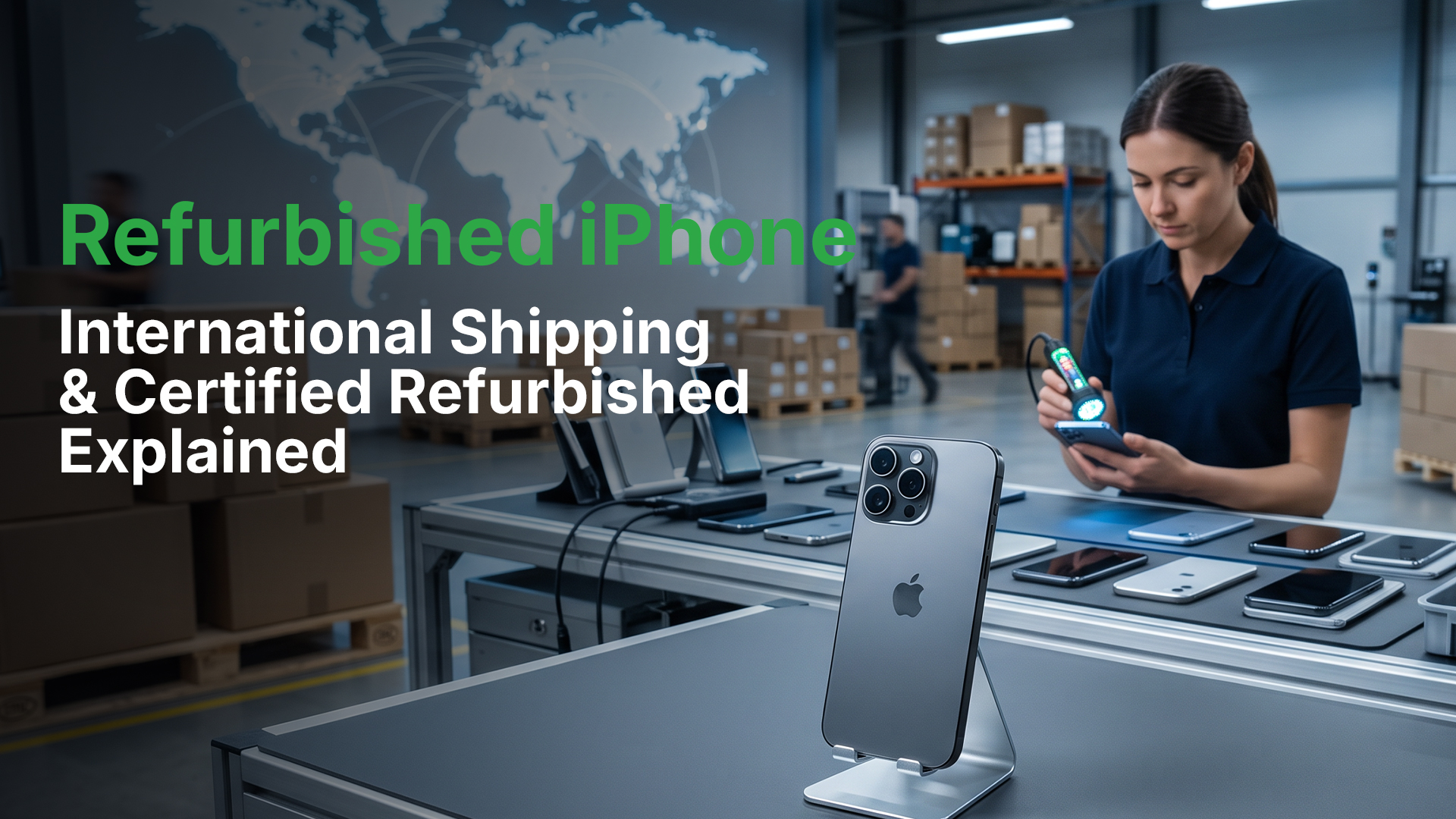
Buying refurbished iPhones from an international supplier is one of the most common ways resellers build inventory. It opens up better pricing, wider model availability, and access to suppliers with stronger refurbishment standards than what might be available locally. But cross-border buying adds layers that domestic purchasing does not: customs clearance, shipping regulations, network compatibility, and compliance documentation.
This is where certified refurbished matters in a way most people do not think about. Certification is not just a quality label. It is a set of documented records, per-unit data, and compliance paperwork that makes international shipping smoother, customs clearance faster, and your risk as a buyer significantly lower. This guide explains what certified refurbished means for international buyers and walks through everything you need to know before placing a cross-border order.
What certified refurbished means for international buyers
A certified refurbished iPhone is one that has passed a documented inspection and repair process, been graded to a defined standard, and ships with a warranty. For a domestic buyer, that means quality and reliability. For an international buyer, it means all of that plus something equally important: paperwork that holds up at the border.
When a shipment of refurbished iPhones crosses an international border, customs authorities want to know what is in the box, what condition it is in, what it is worth, and whether it meets local regulations. A certified refurbished shipment from a professional supplier comes with all of that documented: a per-unit manifest listing every IMEI, model, storage capacity, grade, and battery health, alongside commercial invoices, packing lists, certificates of origin, and compliance certifications. That documentation is what separates a shipment that clears customs in days from one that gets held for weeks or rejected entirely.
At ReMobile, every iPhone goes through a 52-point inspection across eight categories before it ships. Each device carries a unique batch ID, a certificate with full traceability from intake to final grade, and a new battery installed at 100 percent health. That level of documentation is not just about quality. It is about giving customs authorities and your own business exactly the records they need to move goods across borders without surprises.
What to check before buying internationally
International sourcing is straightforward once you understand the four areas where cross-border orders differ from domestic ones. Here is each one.
Network and band compatibility
Not every iPhone works on every network worldwide. iPhones are manufactured in regional model variants, and each variant supports a specific set of LTE and 5G frequency bands. A phone that works perfectly in one country may not connect to the fastest networks in another if the bands do not match.
For resellers, this matters because your customers expect the phone to work on their local carrier without issues. Before ordering, confirm that the iPhone models your supplier carries support the bands used by the carriers in your market. The safest approach is to buy factory-unlocked iPhones from a supplier that stocks models compatible with global networks.
ReMobile supplies factory-unlocked iPhones that are verified carrier-free during the 52-point inspection. The wireless and connectivity checks confirm Wi-Fi, Bluetooth, cellular reception, GPS, NFC, and SIM activation, so what arrives in your market is ready to connect.
Customs duties and documentation
Every country charges customs duties on imported electronics, and the rates vary widely. Refurbished phones typically fall under HS code 8517, but the duty rate on that code ranges from zero in some free trade zones to over 20 percent in more protective markets. Knowing the rate for your country before you order is essential, because it directly affects your landed cost and your margin.
The documentation a customs authority expects usually includes a commercial invoice stating the value and description of every unit, a packing list matching the invoice, a certificate of origin confirming where the goods were refurbished, and any regional compliance certifications required for electronics in your country.
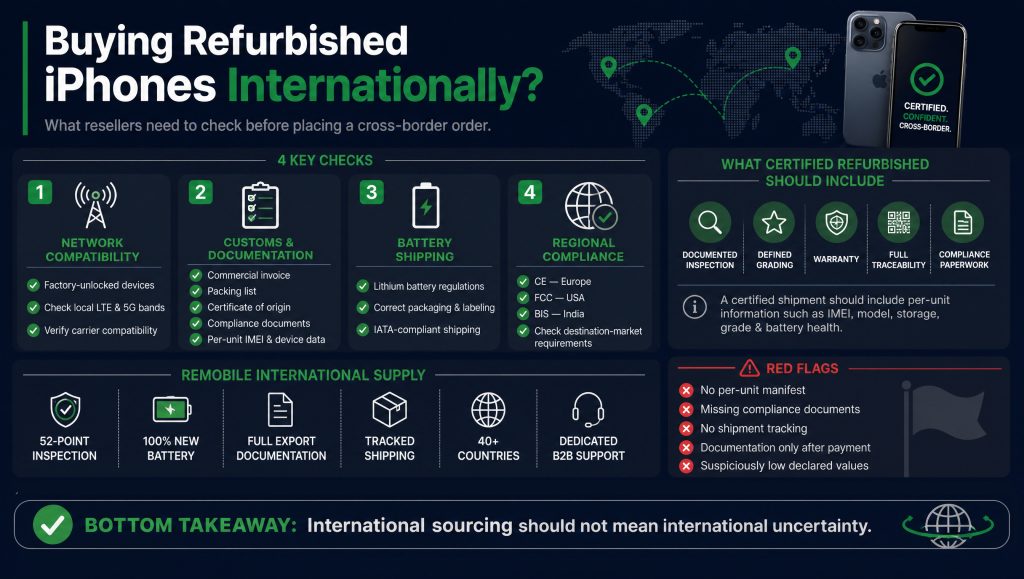
A supplier that handles export documentation as part of their process saves you time and reduces the risk of clearance delays. ReMobile provides full export documentation and compliance paperwork with every shipment from Dubai, built into the process rather than added as an afterthought.
Lithium battery shipping regulations
Every iPhone contains a lithium-ion battery, and lithium batteries are classified as dangerous goods for air transport under IATA regulations. That classification applies whether the phone is new or refurbished, and it governs how the shipment must be packaged, labeled, and documented.
The practical impact for a reseller is simple: your supplier needs to handle this correctly, or your shipment can be delayed, returned, or refused by the carrier. Proper packaging means anti-static and shock-resistant materials. Proper labeling means the correct UN3481 hazard markings. Proper documentation means the shipper has declared the lithium battery content in compliance with IATA rules.
This is not something you should have to manage yourself. A professional supplier packages and ships to these standards as a matter of course. At ReMobile, every shipment uses anti-static, shock-resistant packaging designed for safe international transit, with documentation that meets air transport requirements.
Regional compliance certifications
Different countries require different compliance certifications before electronics can legally enter the market. The most common ones resellers encounter are FCC certification for the United States, CE marking for the European Union, and BIS certification for India. Other markets have their own requirements.
For iPhones, Apple’s original certifications generally carry through to the refurbished device as long as the core hardware has not been altered in a way that changes its radio frequency characteristics. However, some markets require additional documentation or re-certification for refurbished units, particularly if the battery has been replaced or firmware has been updated.
Your supplier should be able to tell you which certifications their stock carries and provide the documentation to prove it. If they cannot, you risk a shipment that clears the port but cannot legally be sold in your market, which is worse than a shipment that gets held at the border because at least a held shipment gets resolved.
ReMobile’s refurbishment process follows ISO-aligned standards with CE certification and WEEE compliance. The documentation ships with the order, so your compliance position is clear before the goods arrive.
What ReMobile handles for international resellers
A large part of the complexity in cross-border sourcing disappears when your supplier builds it into their process instead of leaving it to you. Here is what that looks like in practice with ReMobile.
Every shipment leaves our Dubai facility with full export documentation: commercial invoices, packing lists, certificates of origin, and compliance certifications matched to the destination market. The manifest lists every unit by IMEI, model, storage, grade, and battery health, which gives customs authorities and your own receiving team exactly the data they need.
Packaging is designed for international transit. Anti-static and shock-resistant materials protect the devices, and lithium battery labeling meets IATA requirements for air freight. Pallet-optimized bulk packaging is available for larger orders, and white-label or custom-branded packaging is offered for orders of 100 units or more, so devices arrive retail-ready if your operation needs that.
Shipping runs from Dubai to over 40 countries, with tracked delivery across Europe, the Middle East, Africa, and Asia. Dubai’s position as a global logistics hub means transit times to most major markets are shorter than shipping from the US or China, with well-established freight routes and customs channels. Our B2B partners also get dedicated account management, so questions about a specific shipment or a customs query get handled directly rather than through a generic support channel.
The result for a reseller is simple. You place the order, receive tracked shipping confirmation, and the goods arrive with every document your customs broker needs to clear them. The complexity stays on our side.
Red flags when buying internationally
Not every international supplier operates to the same standard, and the risks are higher when goods cross a border because problems are harder and more expensive to resolve. Watch for these warning signs before committing to an order.
No manifest or incomplete manifests. If a supplier cannot provide a per-unit list with IMEIs, models, grades, and battery health before shipment, you have no way to verify what is in the box until it arrives, and by then your money has already moved.
No compliance documentation. A supplier that cannot tell you which certifications their stock carries or provide the paperwork is leaving you exposed to customs holds and potential legal issues in your market.
No tracked shipping. International shipments without tracking are a gamble. If the shipment disappears or is delayed, you have no visibility and no leverage.
Pressure to pay before seeing documentation. A professional supplier provides documentation as part of the sales process, not as a concession after you push for it. If paperwork only appears after payment, the relationship is already on the wrong footing.
Declared values that look low. Some suppliers undervalue shipments on customs declarations to reduce the buyer’s duty bill. This is fraud in most jurisdictions, and if customs catches it, the shipment gets held, fines follow, and your business relationship with that customs authority is damaged going forward.
FAQ
Do I need a business license to import refurbished iPhones?
In most countries, yes. Commercial importation of electronics for resale requires a business registration and often a specific import license or trade permit. Requirements vary by market, so check with your local customs authority or a licensed broker before placing your first international order.
How long does international shipping take from Dubai?
It depends on the destination and shipping method. Air freight to most European and Middle Eastern markets typically takes 3 to 7 business days. Asia and Africa vary more widely. ReMobile provides tracked shipping on every order so you can follow the shipment from dispatch to delivery.
Will I have to pay customs duties on refurbished iPhones?
Almost always, yes. Customs duties on electronics under HS code 8517 vary by country. Some free trade zones charge zero duty, while other markets charge 10 to 20 percent or more. Factor the duty rate for your market into your landed cost before ordering so your margin calculation is accurate.
How do I know the iPhones will work on my local network?
Confirm that the model variant your supplier stocks supports the LTE and 5G bands used by carriers in your market. Factory-unlocked iPhones that support global band configurations work in most markets without issues. Ask your supplier for the model numbers so you can verify band compatibility before ordering.
What happens if a shipment is held at customs?
It depends on why. Missing documentation is the most common cause and is usually resolved by providing the required paperwork. A professional supplier that includes full export documentation with every shipment significantly reduces this risk. If a shipment is held, work with your customs broker and your supplier to resolve it quickly.