
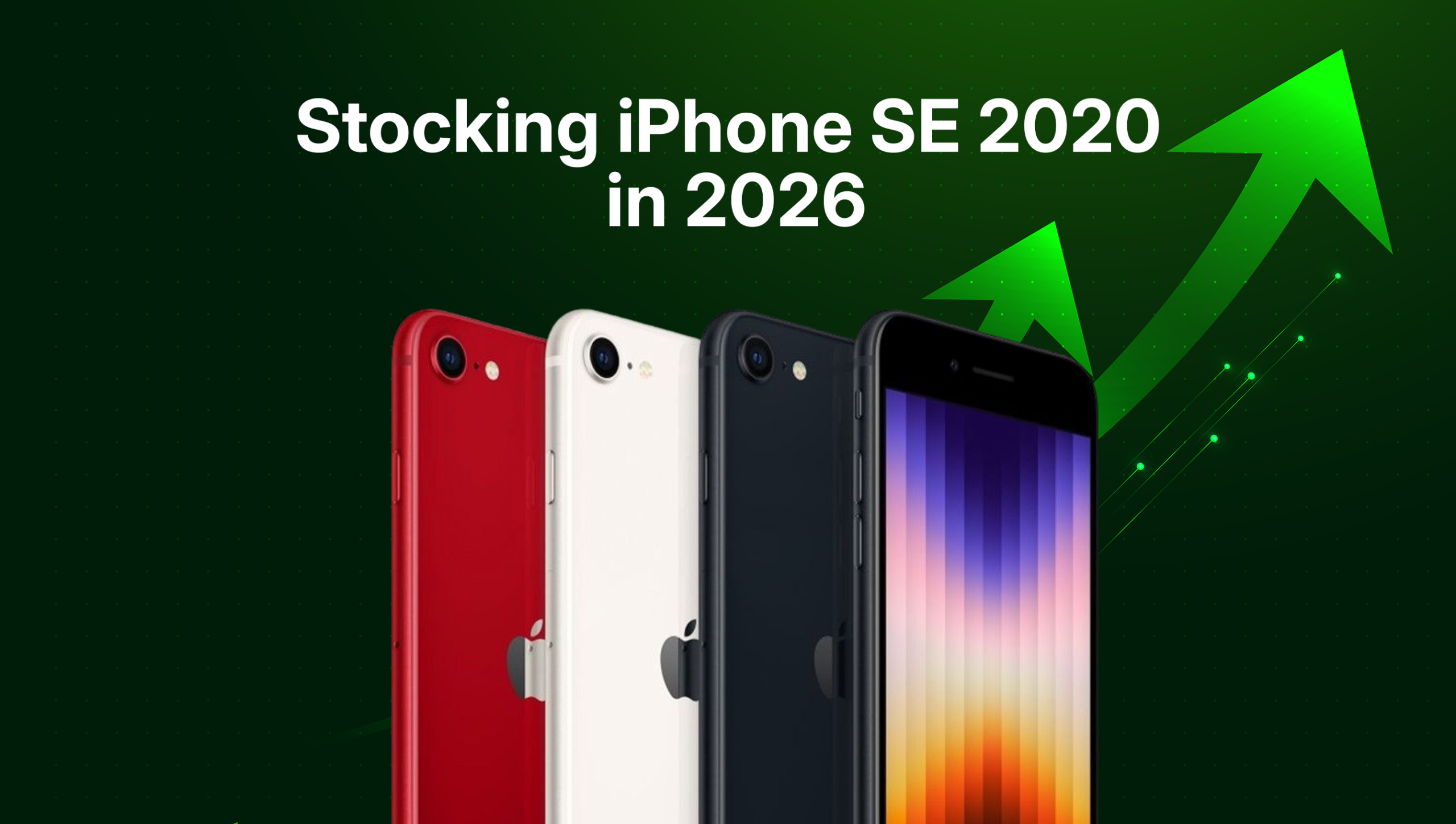
The iPhone SE 2020 is the cheapest iPhone that still runs the latest iOS. Refurbished units sell for under $100, sourcing costs are rock bottom, and it technically does everything a basic smartphone needs to do. On paper, that looks like easy budget stock.
But cheap to source does not always mean profitable to sell. The SE 2020 is six years old, built on a design from 2014, and almost certainly heading for its last year of iOS support. Before you put any capital into it, you need the full picture of where this phone actually stands, who is still buying it, and what the risks are if it sits in your inventory too long.
Where the iPhone SE 2020 stands in late 2026
The iPhone SE 2020 runs iOS 27, which Apple released on September 14, 2026. That was a genuine surprise. Most predictions had the SE 2020 losing support a year earlier, but Apple extended it, making the A13 Bionic the oldest chip still running the current iOS.
Here is what the phone is in late 2026:
- A13 Bionic chip with 3GB of RAM, the lowest RAM of any supported iPhone
- 4.7-inch LCD display with Home button and Touch ID, the same body as the iPhone 8
- Single 12MP rear camera, no Night Mode, no computational photography beyond basic Smart HDR
- 1,821 mAh battery, the smallest of any iPhone Apple still supports
- Lightning connector, no USB-C
- No 5G, no Face ID, no MagSafe, no Apple Intelligence
- Storage options: 64GB, 128GB, 256GB
The phone works. It makes calls, runs apps, browses the web, and handles messaging without trouble. For light, everyday use it is fine. But every feature trend in the iPhone lineup has moved away from this phone, and buyers can see that the moment they hold it next to anything with an edge-to-edge display.
Who is still buying the SE 2020
The SE 2020 serves a narrow but real set of buyers. Understanding who they are helps you decide whether your market has enough of them to justify stocking it.
First-time iPhone owners in price-driven markets. In regions where a sub-$100 iPhone opens the door to the Apple ecosystem for the first time, the SE 2020 is the entry ticket. These buyers care about getting an iPhone, any iPhone, at the lowest possible price. They are not comparing specs. They are comparing price tags.
Parents buying for children. A cheap, durable iPhone with a small screen and basic functionality is exactly what some parents want for a child’s first phone. The Home button and Touch ID are actually advantages here because they are simple and familiar.
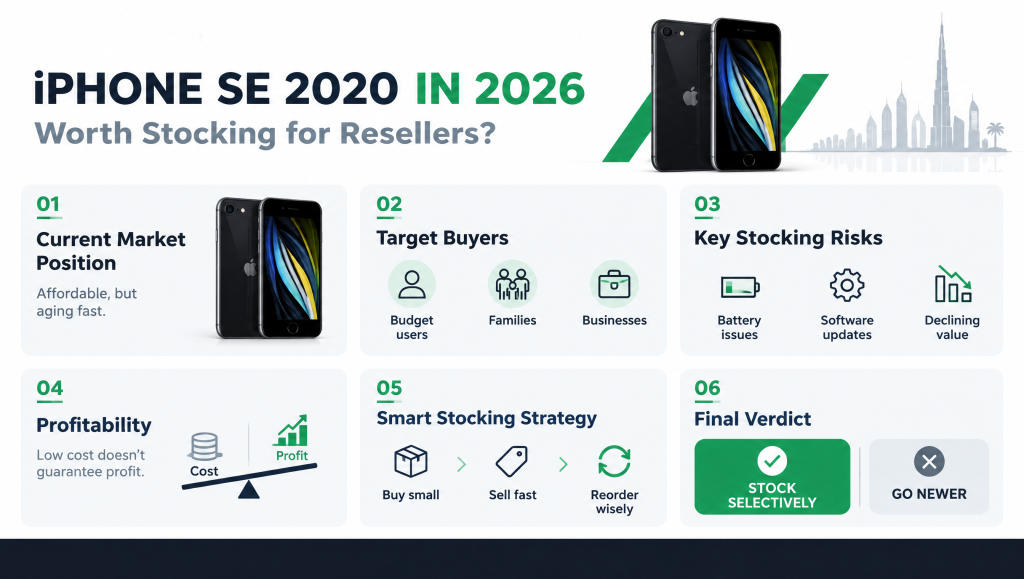
Businesses outfitting staff with basic smartphones. Companies that need to hand out phones for calls, email, and messaging do not need Face ID or a ProMotion display. They need something that works, runs current software, and costs as little as possible per unit.
Buyers who specifically prefer the compact size and Touch ID. A small group, but a loyal one. Some people genuinely prefer the 4.7-inch form factor and a physical Home button over the gesture-based, larger phones Apple now makes.
If your market has a meaningful share of any of these segments, the SE 2020 can still move. If your market skews toward buyers who compare screens, cameras, and features, this phone will sit.
The risks of stocking it now
The SE 2020 is cheap to source, but the risks are real and they compound the longer you hold it.
iOS 28 will almost certainly drop it
The A13 chip is the oldest Apple supports on iOS 27. When iOS 28 arrives in late 2027, the SE 2020 is the most likely model to be cut. Apple will continue to provide security patches for a while after that, but the moment a phone loses major iOS support, buyer demand drops sharply. Resellers who have seen this cycle before know the pattern: the announcement lands, prices fall, and stock that was moving at $90 suddenly struggles at $60.
That gives you roughly 12 months of confident selling before the iOS 28 announcement, likely in June 2027, changes the conversation. Any SE 2020 stock you hold past that point carries real depreciation risk.
The design feels dated
The iPhone 8 body with its thick top and bottom bezels, Home button, and small screen looks noticeably old next to any iPhone from the 12 onward. In a shop or an online listing, a buyer scrolling through options will see the SE 2020 and immediately register that it looks like a phone from another era.
That perception affects sell-through speed. Even buyers who do not care about specs respond to how a phone looks, and the SE 2020 loses that comparison every time. Clear, honest photos and listings that emphasize the price advantage rather than the hardware are the way to manage this.
Battery life is the weakest in the lineup
The 1,821 mAh battery was small when the phone launched in 2020. In 2026, with iOS 27 running on aging hardware, battery life is the SE 2020’s most common complaint. Light users get through a day. Anyone who uses their phone regularly will not.
Even with a new battery installed, the capacity is what it is. You cannot change the size of the battery, only restore it to its original health. For a reseller, this means the SE 2020 is the most likely model in your inventory to generate a battery-related complaint, even when the battery health reads 100 percent. Setting expectations clearly in your listing is the best defense.
No 5G, no Face ID, no MagSafe, no Apple Intelligence
Every major feature Apple has introduced since 2020 is absent from the SE 2020. No 5G means buyers in markets with strong 5G coverage are on a slower connection. No Face ID means the phone uses a security method Apple has otherwise moved away from. No MagSafe means no wireless charging accessories from the current ecosystem. No Apple Intelligence means the phone misses the AI features Apple is actively marketing across every other current model.
None of these are dealbreakers for the specific buyer segments the SE 2020 serves. But they limit the pool to only those segments, with no crossover appeal to anyone shopping on features.
The case for stocking it (carefully)
There is a case for stocking the SE 2020, but it comes with conditions.
The phone works well for what it is: a functional, fully supported iPhone at the lowest price point in the market. In budget-driven markets where sub-$100 iPhones have genuine demand, it fills a slot that no other model can match on price. The sourcing cost is near the floor, which means you can offer a price that is impossible to match with any newer model.
If you stock it, do it with three rules. First, source it at a cost that leaves a workable margin at a sub-$100 selling price, because that is where this phone lives. Second, turn it fast. Do not hold SE 2020 inventory speculatively. Buy what you can sell within 30 to 60 days and reorder only if it moved. Third, list it honestly. Describe it as a budget iPhone that runs the current iOS, not as a phone that competes with the iPhone 12 or 13 on anything except price. Honest positioning attracts the right buyer and prevents the returns that eat your margin.
The verdict
Stock the iPhone SE 2020 only if your market has proven demand for sub-$100 iPhones and you can source it cheaply enough that the thin margin works. Keep quantities small, turn stock quickly, and do not plan to carry it past mid-2027 when the iOS 28 announcement will likely end its run.
If your market does not specifically need a phone this cheap, skip it entirely and put that capital into iPhone 12 or 13 stock where the margins are better, the demand is broader, and the remaining useful life is significantly longer. A slightly higher per-unit cost on a model that sells faster and for more money will almost always produce a better return than a low-cost model that sits or generates complaints.
The SE 2020 is not a bad phone. It is a phone at the end of its life. Stock it like one.
FAQ
How long will the iPhone SE 2020 be supported? It currently runs iOS 27, released September 2026. It is very likely to lose support with iOS 28 in late 2027. After that, Apple will continue to provide security patches for some time, but major iOS updates and new features will stop. For a reseller, that means confident selling through roughly mid-2027.
Is the SE 2020 the same as the iPhone 8? No, but they share the same body and screen design. The SE 2020 has the A13 Bionic chip, which is two generations ahead of the iPhone 8’s A11, and that chip difference is why the SE 2020 still runs iOS 27 while the iPhone 8 stopped at iOS 16. Internally, it is a more capable phone.
Should I stock the SE 2020 or the SE 3rd generation instead? The SE 3rd generation is a better option if you are going to stock the budget tier. It has the A15 chip, 5G support, 4GB of RAM, and will be supported by iOS for longer. It costs a little more to source but carries less risk and will sell for longer. If your budget only allows one, the SE 3rd gen is the safer bet.
What storage size should I stock on the SE 2020? 128GB if available. The 64GB base is increasingly tight for buyers, and the 256GB is hard to justify at this price point because the storage premium pushes the phone above $100 where it starts competing with models that are better in every other way.
Conclusion
The iPhone SE 2020 still works and still sells, but its window is closing. Stock it only if your market needs sub-$100 iPhones, source it cheap, sell it fast, and plan your exit before iOS 28 changes the conversation. For refurbished iPhones across every model and tier with verified grading and a new battery on every unit, explore our range at remobile.ae.