
A refurbished iPhone should come with a warranty. That single fact is what separates a legitimate refurbished phone from a gamble. But warranty on a refurbished device works differently than warranty on a new one, and the details matter more than most buyers and sellers realize.
For resellers, warranty is not just a customer-facing feature. It works on two levels: what your supplier warrants to you, and what you then offer to your customers. Getting both layers right protects your margins, reduces disputes, and builds the kind of trust that turns first-time buyers into repeat business. This guide covers the full picture.
Do refurbished iPhones have a warranty?
Yes. A refurbished iPhone from a reputable seller comes with a warranty. The warranty covers functional defects, meaning if something stops working that should work, you are covered.
That said, the warranty on a refurbished iPhone is almost never from Apple. It is from the seller who refurbished or sold the phone. The length, the coverage, and the claims process all depend on who you bought from. Some sellers offer 30 days. Others offer a full year or more. The difference is enormous, which is why reading the warranty terms before buying is just as important as checking the grade or the battery health.
The only exception is Apple Certified Refurbished, which we cover next.
Apple warranty vs seller warranty
This is the question that causes the most confusion in the refurbished iPhone market, so here is the clear answer.
Apple Certified Refurbished iPhones carry a one-year Apple limited warranty, identical to the warranty on a brand new iPhone. They are also eligible for AppleCare+ at the standard price, which extends coverage further. Apple refurbishes these devices itself using genuine Apple parts, fits a new battery and outer shell, and sells them through its own refurbished store. This is the only way to get an Apple warranty on a refurbished iPhone.
Every other refurbished iPhone, whether from a third-party refurbisher, a marketplace, or a wholesale supplier, carries the seller’s own warranty, not Apple’s. Apple does not warrant devices it did not refurbish. If a third-party seller implies that their refurbished iPhone has an Apple warranty, that is misleading. The warranty is theirs, not Apple’s.
This does not mean third-party warranties are worse. A strong seller warranty can be just as protective as Apple’s, and often more practical because the claims process is faster and more direct. What matters is that the warranty exists, it is clearly stated, and you know exactly what it covers before money changes hands.
For resellers buying in bulk, you are almost always buying from a third-party refurbisher, not from Apple’s refurbished store. That means your supplier’s warranty is your safety net, and the strength of that warranty directly affects your risk on every order.
What a supplier’s warranty should cover
When you are buying refurbished iPhones in bulk for resale, the supplier’s warranty is what stands between you and a loss on defective stock. Not all supplier warranties are equal, and the differences show up in your margins.
A good supplier warranty should cover functional defects that were present at the time of sale or that emerge within the warranty period. That includes things like a screen that stops responding, a camera that fails, a charging port that dies, cellular or Wi-Fi connectivity problems, and battery defects. These are the faults that make a phone unsellable and that a proper inspection should have caught.
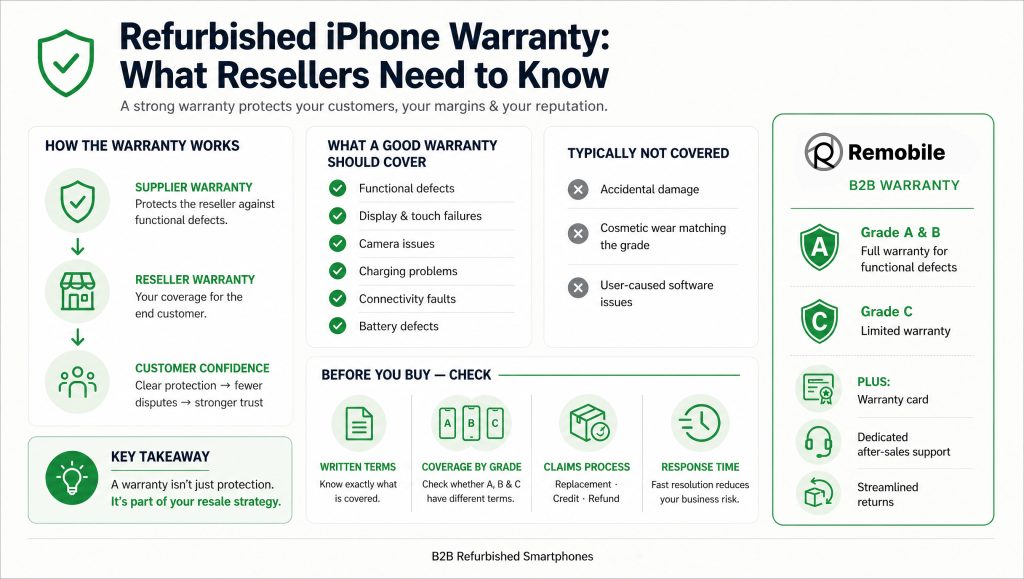
What a warranty typically does not cover is cosmetic wear consistent with the stated grade, accidental damage after delivery, and software issues caused by the end user. That is standard and reasonable.
Here is what to look for in a supplier’s warranty terms before you commit to an order:
- A clear, written warranty policy. If the warranty is not documented, it does not exist in any way you can enforce.
- Per-grade warranty terms. Some suppliers offer a full warranty on Grade A and Grade B, and a limited warranty on Grade C. That distinction should be stated upfront so you can factor it into your pricing and your own customer commitments.
- A defined claims process. How do you report a defective unit? How quickly does the supplier respond? Is the resolution a replacement, a credit, or a refund? A warranty is only as useful as the process behind it.
- A streamlined returns path. Returning a faulty phone to a supplier should not require weeks of back and forth. The faster the process, the less it costs you in time and lost sales.
At ReMobile, every Grade A and Grade B iPhone ships with a full warranty covering functional defects, and Grade C units come with a limited warranty. Each device ships with a warranty card, and B2B partners have access to dedicated after-sales support and a streamlined returns process for any quality concerns. That kind of structure means a defective unit is a quick resolution, not a drawn-out problem.
Why warranty matters for your resale business
As a reseller, the warranty you offer your customers is one of the strongest tools you have. It does four things that directly affect your bottom line.
First, it reduces returns and disputes. A customer who knows they can come back if something goes wrong is far less likely to file a chargeback or leave a negative review. The warranty gives them a path, and most people prefer to use it rather than escalate.
Second, it justifies your pricing. A refurbished iPhone with a clear warranty commands a higher price than the same phone sold with no cover. Buyers are paying for the assurance as much as the device. That difference goes straight into your margin.
Third, it builds repeat business. A customer who buys a refurbished iPhone, uses it for months without issues, and knows they had a warranty behind them the whole time is a customer who comes back. That is where lifetime value lives.
Fourth, it separates you from the competition. Many small resellers sell with no warranty, or bury it in fine print. Offering a visible, simple warranty makes you stand out immediately, especially in markets where trust in refurbished devices is still developing.
The cost of not offering a warranty is real. More disputes, more chargebacks, more one-star reviews, and a reputation that quietly drives buyers elsewhere.
How to structure a warranty for your customers
Offering a warranty to your end customers does not mean absorbing unlimited risk. It means building a clear, fair policy that protects your buyers without destroying your margins, and using your supplier’s warranty as the safety net underneath.
Start with coverage length. Match or stay within the coverage your supplier offers you. If your supplier gives you a full warranty on Grade A and B stock, you can confidently offer your customers a similar window. Going beyond what your supplier covers means you are on your own for any claim that falls outside their terms, so know the limits.
Define what is covered and what is not. Functional defects should be covered: the phone stops making calls, the screen fails, the camera dies. Cosmetic wear that matches the stated grade should not be covered, and neither should accidental damage. State these clearly in your listing or your returns policy. Ambiguity is what creates disputes.
Keep the claims process simple. The easier it is for a customer to reach you and get a resolution, the less likely they are to escalate through the platform or their payment provider. A clear process also means fewer hours spent on each claim, which protects your time as much as your money.
Use your supplier’s warranty as your backstop. When a customer returns a phone with a genuine functional defect, your supplier’s warranty is how you recover the cost. You replace or refund the customer, then claim against your supplier. This is why the supplier’s claims process matters so much. If it takes three weeks to get a credit, you are carrying that cost for three weeks.
One practical note: track your warranty claims by model, grade, and supplier. If a pattern emerges, like a specific model or grade generating more claims than others, that data helps you adjust your stock mix and your sourcing decisions. Warranty data is business intelligence if you use it.
FAQ
Do refurbished iPhones have an Apple warranty?
Only if you buy Apple Certified Refurbished directly from Apple. Every other refurbished iPhone carries the seller’s warranty, not Apple’s. Third-party refurbished iPhones have no Apple warranty regardless of how they are marketed.
Can you add AppleCare to a refurbished iPhone?
Only to Apple Certified Refurbished devices purchased from Apple’s refurbished store. Third-party refurbished iPhones are not eligible for AppleCare. Some third-party sellers offer their own extended warranty options instead.
How long is a typical refurbished iPhone warranty?
It varies by seller. Warranties range from 30 days to two years. Apple Certified Refurbished comes with one year. Among third-party refurbishers, 12 months is common for higher-grade stock, while lower grades may carry shorter or limited coverage. Always check the specific terms before buying.
What happens if a refurbished iPhone breaks after the warranty expires?
You are responsible for the repair cost, the same as with a new phone after its warranty period ends. This is why warranty length matters and why some resellers factor in the cost of post-warranty repairs when pricing their stock.
Should resellers offer a longer warranty than their supplier provides?
Only if you are prepared to cover the cost of claims beyond your supplier’s coverage window. Extending beyond your supplier’s terms means self-insuring that portion, which can work if your defect rate is low and your margins are healthy, but it is a risk you should calculate, not guess at.
Conclusion
Warranty is what turns a refurbished iPhone from a risk into a reliable product, both for the reseller buying stock and the customer buying the phone. Know exactly what your supplier covers, build a clear warranty for your own customers, and use claims data to sharpen your sourcing over time. For refurbished iPhones backed by a full warranty on Grade A and B stock with dedicated B2B after-sales support, explore our range at remobile.ae.