
Black Friday is the single biggest sales week of the year for refurbished iPhones. In 2025, refurbished phone sales during Black Friday week outpaced new phone sales in every major market. In the UK, refurbished grew 36.5 percent week over week while new grew 26.3 percent. In Germany, refurbished surged 63.9 percent. In Spain, 51.9 percent.
Those numbers are not a coincidence. Buyers who already want to save money are even more motivated during a week built around saving money. Refurbished sits perfectly in that window. But the resellers who actually capture that demand are the ones who planned weeks before the sale started. This guide covers every decision you need to make, from what to stock to how to price it, so you are ready when November 27 hits.
Black Friday for Refurbished iPhones Resellers
Black Friday week generates more than double the sales value of an average week in the refurbished phone market. That alone makes it the most important week on your calendar. But the real story is what has been happening to the split between refurbished and new.
In every tracked European market in 2025, refurbished phone sales grew year over year while new phone sales declined. The UK saw refurbished grow 12.9 percent year over year. Germany saw 58.8 percent growth. Spain, 57.5 percent. New phones went the other direction in all three markets. Buyers are not just choosing refurbished during Black Friday because it is cheaper. They are actively choosing it over new.
Two things are driving this. First, the price gap between new flagship iPhones and refurbished models one generation back has widened as Apple pushes new prices higher. A buyer looking at an iPhone 17 at $799 new and an iPhone 16 refurbished at $440 does not need a sales pitch. The math does the work. Second, consumer trust in refurbished quality has grown substantially. Buyers who tried refurbished once are coming back, and Black Friday gives them the push to buy again.
For resellers, this means Black Friday is not just a spike. It is an accelerating trend that rewards the suppliers who prepare for it properly.
What to stock and how much?
The wrong stock mix is the most expensive mistake you can make for Black Friday. Too much of a slow mover and your capital is locked up during the highest-demand week of the year. Too little of a fast mover and you leave money on the table. Here is how to think about it.
Model selection
Your Black Friday stock should lean heavier toward volume movers than your normal inventory. This is not the week to experiment with niche models. Buyers are in a hurry, they are comparing prices, and they gravitate toward models they already know they want.
The iPhone 16 should be your deepest stock for Black Friday 2026. It is one generation behind the current iPhone 17, it supports Apple Intelligence, and the refurbished discount versus new is large enough to make the deal feel obvious. The iPhone 15 is your second-heaviest stock. It offers the best dollar savings in the lineup and moves quickly among price-conscious buyers. The iPhone 14 and 13 round out the budget tier for buyers who want an iPhone at the lowest possible price.
For margin, carry a smaller allocation of iPhone 17, 16 Pro, and 17 Pro units. These sell slower but each sale contributes more. During Black Friday, even premium buyers shop harder, so the discount on a refurbished Pro model can be the thing that closes a sale you would not get in a normal week.
Storage sizes
This is where most resellers understock. In 2025, high-storage refurbished phones saw the biggest Black Friday spikes of any segment. 512GB models rose 140 percent in Spain and 167 percent in Germany. 1TB models rose 123 percent in the UK.
The reason is straightforward. Buyers who want high storage are usually premium buyers, and premium buyers are the ones most likely to shop refurbished during a sale event because the savings on a high-storage model are the largest in absolute terms. A 256GB iPhone 16 Pro refurbished saves a buyer $200 to $300 versus new. A 1TB iPhone 16 Pro Max refurbished saves even more. That gap is the sale pitch.
Stock 128GB and 256GB as your base across all models. But for the iPhone 16 Pro and above, carry more 512GB and 1TB units than you normally would. They will move.
Grade mix
Shift your grade mix slightly toward Grade A for Black Friday. During the rest of the year, Grade B is the sweet spot for most markets. But Black Friday buyers include a larger share of first-time refurbished customers who need the phone to look and feel as close to new as possible. Grade A removes the last objection for those buyers.
A reasonable Black Friday split is 40 percent Grade A, 45 percent Grade B, 15 percent Grade C. Your normal mix might be closer to 25/55/20. The shift does not need to be dramatic, but it should be intentional.
Quantity planning
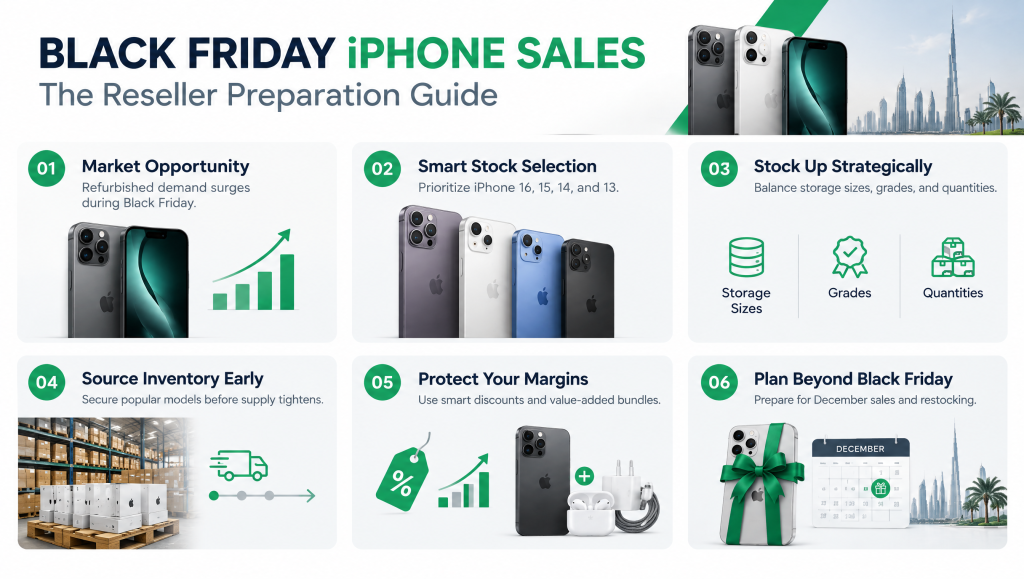
Use last year’s Black Friday sales as your baseline, then add 15 to 20 percent. If this is your first Black Friday as a reseller, use your best recent month’s sales and multiply by 2.5 to estimate your Black Friday week volume. It is better to slightly overstock and carry a small surplus into December, which is still a strong selling month, than to run out mid-week and miss sales you cannot recover.
When to source your Black Friday inventory?
Timing your sourcing is the difference between healthy margins and squeezed ones. The refurbished iPhone supply chain has its own rhythm around Q4, and if you buy at the wrong moment, you pay more than you need to.
The best sourcing window for Black Friday stock is mid-September through mid-October. Here is why. Apple launches new iPhones in September, which triggers a wave of trade-ins. Those trade-ins enter the refurbished pipeline roughly 60 to 90 days later. But smartly, you do not wait for that wave to hit. You source your core Black Friday stock from existing supply in September and early October, before other resellers start competing for the same inventory.
By mid-October, the market tightens. Demand for popular models rises as resellers stock up, and suppliers either raise prices or run low on the configurations you need. Q4 shipping times can increase by up to 40 percent, which means a late order might not arrive in time even if the stock is available.
If you are reading this in late October, you are not too late, but you need to move now. Place your core orders this week for iPhone 16, 15, 14, and 13 across the storage sizes and grades you need. Lock in pricing with your supplier if they offer fixed Q4 contracts. Every week you wait from here increases the chance that your top configurations are unavailable or more expensive.
One more thing. Build a relationship with your supplier before Black Friday, not during it. Suppliers prioritize their established accounts when stock is tight. If you have been ordering regularly from a supplier like ReMobile, you are in a stronger position to get the allocation you need when everyone else is scrambling.
How to price for maximum margin, not maximum discount?
The biggest mistake resellers make during Black Friday is discounting too deeply. Black Friday buyers expect a deal, but refurbished iPhones already are the deal. Your pricing strategy should protect your margin while making the buyer feel they got something extra.
Start with your floor
Calculate the lowest price you can sell each model and grade at while still making a margin that justifies the work. That is your price floor. Never go below it, no matter what a competitor is doing. A sale that loses money is worse than no sale at all.
For refurbished iPhones, healthy Q4 margins sit in the 15 to 25 percent range depending on the model and grade. Grade A on popular models will be closer to 15 percent because competition is fiercest there. Grade B and C on mid-range models can hold 20 to 25 percent because fewer resellers stock them aggressively.
Discount from your normal price, not from new
Frame your Black Friday discount as a percentage off your regular refurbished price, not as a comparison to the new retail price. Your regular pricing already includes the refurbished discount versus new. Stacking a Black Friday discount on top of that makes the deal feel exceptional without requiring you to cut deeply.
A 10 to 15 percent discount off your normal refurbished price is enough to create urgency. At that level, a buyer sees a genuine saving, you protect your margin, and the sale still feels like a Black Friday deal. Going above 20 percent usually hurts more than it helps because refurbished margins are already thinner than new.
Use bundles instead of deeper discounts
If you want to offer more value without cutting price further, bundle. A refurbished iPhone with a new case and screen protector costs you very little extra but increases the perceived value of the package significantly. Accessories carry 25 to 40 percent margins, so the bundle actually improves your overall margin per sale while making the buyer feel they are getting more.
For B2B buyers ordering in bulk, offer volume-tiered pricing instead of flat discounts. Two percent off at 50 units and 5 percent off at 200 units encourages larger orders without giving away margin on small ones.
Adjust prices through the week
Do not set your Black Friday price and leave it. Check competitor pricing daily during Black Friday week and adjust. If a model is moving faster than expected, you have room to raise the price slightly. If something is sitting, a small additional cut is better than holding dead stock. The goal is to sell through your inventory by the end of the week, not to hold firm on a price that is not working.
How to position your listings and marketing
Black Friday is noisy. Every reseller, retailer, and marketplace is screaming about deals at the same time. Your job is not to be the loudest. It is to be the clearest.
For B2B buyers
Your B2B customers are not browsing deal pages. They are planning their own Black Friday stock. Reach out to them directly, ideally by late October, with a curated list of what you have available for Black Friday allocation. Include the models, storage sizes, grades, quantities, and pricing tiers. Make it easy for them to place one order and get everything they need.
The pitch is simple. You have inspected, graded, and certified stock ready to ship before Black Friday. They do not need to deal with multiple suppliers or worry about quality inconsistency during the busiest week of the year. Every iPhone comes with a new battery, verified IMEI, and a warranty card. That reliability is the value, not the discount.
If you are sourcing from ReMobile, you already have the documentation to back this up. Every unit comes with a unique batch ID, photographed condition records, and a certificate with full traceability. Pass that assurance through to your buyers. It is what separates a trusted supplier from a cheap one.
For online listings
Update your product listings before Black Friday, not during it. Write the Black Friday price into the listing, add a note about the sale period, and make sure the grade, storage, battery health, and warranty are all clearly stated. Buyers during Black Friday are comparing quickly. A listing that is missing information loses to one that has it, even if the price is the same.
Photos matter more during Black Friday because a higher percentage of buyers are first-time refurbished customers. They need to see that the phone looks good. If your supplier provides photographed condition documentation per unit, use it in your listings.
Timing your marketing
Start promoting your Black Friday offerings in the first week of November. The old model of a one-day sale is gone. “Black November” is the reality now, with demand building steadily from early November and a secondary peak around Singles’ Day on November 11. By the time Black Friday week arrives, your buyers should already know what you have and at what price. The week itself is for closing, not introducing.
Post Black Friday and December sales
Most resellers go quiet after Black Friday. That is a mistake. The week after Black Friday and the first three weeks of December are a strong secondary selling window that many resellers leave on the table.
Returns
Expect a return rate of 3 to 5 percent on Black Friday sales, slightly higher than your normal rate. Most returns come from first-time refurbished buyers whose expectations did not match the product. If you listed grades, storage, and condition clearly, your return rate will be on the lower end. Process returns quickly and relist the units because December demand is waiting.
December demand
December is gift-buying season, and refurbished iPhones are popular gifts. The buyer profile shifts slightly. December buyers are often shopping for someone else, which means they care more about how the phone looks, in the box and out of it, and less about specs. Grade A stock in retail-ready packaging sells well in December, so keep some Grade A inventory in reserve or restock quickly after Black Friday.
Restocking
If you sold through your Black Friday inventory faster than expected, restock immediately. Do not wait for January. Post-Black Friday sourcing prices often dip slightly as the initial Q4 rush passes, and supply from September trade-ins is now flowing through the refurbished pipeline. You can often source at equal or better prices in early December compared to what you paid in October.
Evaluate your results
Once the dust settles in late December, review three things. Which models moved fastest and which sat. Which grade sold at the highest margin. And which storage size surprised you. Write those answers down and use them to plan next year’s Black Friday stock. The resellers who improve every year are the ones who actually measure what happened instead of guessing from memory.
FAQ
When should I start preparing for Black Friday as a reseller? Mid-September for sourcing inventory, early October for pricing decisions, and first week of November for marketing. If you are starting in late October, focus on placing inventory orders immediately and reach out to your B2B buyers within the next week.
How much discount should I offer on refurbished iPhones for Black Friday? Ten to 15 percent off your regular refurbished price is the sweet spot. Refurbished is already discounted versus new, so you do not need to cut deeply. Going above 20 percent usually hurts your margin more than it helps your volume.
Should I stock more Grade A or Grade B for Black Friday? Shift slightly toward Grade A compared to your normal mix. Black Friday brings in more first-time refurbished buyers who want the phone to look close to new. A 40/45/15 split of A/B/C works for most markets during Black Friday.
What if I have unsold Black Friday stock? December is still a strong selling month, especially for Grade A stock that works well as gifts. Do not panic-discount unsold inventory on December 1. Adjust pricing gradually and let the December demand absorb it. If stock is still sitting by late December, consider offering it to B2B buyers at a modest bulk discount to clear before January.
Is Black Friday worth it for small resellers? Yes, but scale your preparation to your size. Even a small reseller can capture meaningful extra volume during Black Friday week with the right stock, clear listings, and modest discounts. The key is not to overextend on inventory. Stock what you are confident you can sell in a two-week window.
Conclusion
Black Friday is the biggest week of the year for refurbished iPhone sales, and the resellers who win it are the ones who planned their stock, priced with margin in mind, and started early. Source in September and October, price to protect your margin, and keep selling through December. For bulk refurbished iPhones with verified grading, new batteries, and clean IMEIs ready to ship before Black Friday, explore our range at remobile.ae.